Client churn signals: how MSPs spot an at-risk account before the renewal
MSP client churn rarely comes without warning. Which signals in tickets, licenses, and invoices point to an at-risk account, and how to measure what you keep.
- Client churn often feels sudden, but the warning signs usually sit in tickets, license counts, invoices, and meeting notes long before the notice arrives. They are scattered, so nobody reads them together.
- No single signal is a verdict. A pattern across service quality, commercial changes, the relationship, and engagement is what deserves a conversation with the client.
- Churn and revenue retention measure what already happened. Record each client's monthly recurring revenue from now on, keep one-off service revenue apart, and treat a missing month as unknown rather than as a loss.
For a managed service provider, losing a client often feels sudden. The termination notice arrives, the account manager is surprised, and leadership asks what happened. The answer usually comes after the fact: a competitor came in cheaper, or the client “wanted a change.”
Looking back, the warning signs were usually there. Tickets took longer to close. A few licenses were removed. The person who signed the original contract left, and nobody met the successor. Each signal sat in a different system, owned by a different person, and none of them looked serious on its own.
This article is for managed service providers (MSPs) and managed security service providers (MSSPs) who want to reduce client churn: which signals to watch, how to read them together, what to do when they appear, and how to measure the clients and revenue you actually keep.
Why lost accounts catch MSPs off guard
Most MSPs track churn after the fact. A client is counted as lost when the contract ends, and the reasons are reconstructed from memory. Three things make the earlier signals easy to miss.
- The data lives in different places. Service quality sits in the ticketing system of your PSA, license counts in vendor portals, revenue in billing, and the relationship in someone’s calendar. Nobody sees all four at once.
- Each signal looks harmless on its own. One slow ticket, one removed seat, one canceled meeting. Every one of them has an innocent explanation, and most of the time that explanation is true.
- Renewal is the first real checkpoint. If the relationship is only reviewed when the contract is up, the client has often made up their mind before the conversation starts.
The goal is not to predict who will leave. It is to notice early enough that a conversation can still change the outcome.
Client churn signals to watch
The signals fall into four groups. Each group answers a different question about the client relationship.
| Group | Signals to watch | Where the evidence comes from |
|---|---|---|
| Service quality | Resolution times rising, the same problem reopened, more escalations, recurring alerts nobody fixes, patching falling behind | PSA ticket history, RMM and patch reports, alert history |
| Commercial | Seats or licenses removed, paid seats left unassigned, recurring revenue shrinking month over month, invoice disputes, late payments | Billing, license portals, accounts receivable |
| Relationship | Your main contact leaves, a new decision maker arrives, reviews are canceled or postponed, the client asks for a copy of the contract or the notice period | Meeting notes, CRM, email |
| Engagement | Far fewer tickets than usual, requests sent to another provider, projects put on hold | Ticket volume against the client’s own history, the project pipeline, conversations with the client |
A few of these deserve a closer look.
Silence is a signal too. A client who stops opening tickets may simply be running smoothly. It may also mean they have stopped expecting you to solve their problems, or that someone else is already solving them. Compare the volume with the client’s own history, not with other clients.
Unused licenses cut both ways. Paid seats that nobody uses are money the client is wasting. If you don’t raise it, the client may find it during their next budget review and ask what else they have been overpaying for. Pointing it out yourself shows that you are watching their spend, even if removing those seats lowers your invoice.
Shrinking is not yet churn. A client who reduces seats or drops a service is still a client. Treat the reduction as an early commercial signal, and ask why it happened before you process it as routine.
Look for patterns, not single data points
A single signal is a reason to look closer, not a verdict. What deserves attention is a pattern: two or more signals from different groups showing up in the same client within a short span of time.
A practical way to work with this:
- Know each client’s normal. Ticket volume, resolution times, and seat counts vary a lot between clients. A change is only meaningful against that client’s own baseline.
- Review on a fixed cadence. Go through the signals for each client once a month in a short internal account review, and bring what you found to your next regular review with the client. A signal that appears between reviews can still be raised right away.
- Write down what you found. Which signals, from which data, and what you decided to do. Without a record, the same pattern gets rediscovered next quarter.
- Assign an owner. One person is responsible for each at-risk client. A signal that belongs to everyone belongs to no one.
- Check whether it worked. At the next review, look at the same signals for the same client. If they persist, the response did not address the cause.
Illustrative example: in one month, a client removes five seats, their IT contact leaves, and ticket volume falls well below their usual level. Each signal alone has an innocent explanation. Together they span three groups, so the account owner books a meeting with the new contact before the next review.
Weighting signals into a single “health score” can help with a large client base, but only if everyone understands what goes into it. A score nobody can explain gets ignored the first time it disagrees with the account manager’s gut feeling.
How to respond before the renewal
The response depends on what the signals point to. Discounts are rarely the right first move: they treat a service or relationship problem as a price problem, and they tell the client that the previous price was negotiable.
- Service delivery problem: fix it first, inside the current agreement. Then tell the client what went wrong and what you changed, so they have a reason to trust the fix instead of just noticing it. Check, too, whether the agreed scope and SLAs were ever written down at onboarding: unclear expectations are a common source of friction.
- Commercial problem: ask what is behind the change, whether it is fewer seats, a disputed invoice, or a late payment. A client cutting seats because of layoffs needs something different from a client moving workloads to another provider. Our guide on how to upsell cybersecurity services shows how to bring a recommendation that the client can check, instead of a pitch.
- Relationship problem: introduce yourself to the new decision maker before the renewal, not at it. Bring what the client has received so far, in figures they can check. Our article on how to show clients the value of cybersecurity walks through how to do that without overselling.
- Engagement problem: ask directly. “We’ve noticed fewer requests from your team. Is everything working, or is someone else handling some of this now?” is an uncomfortable question. It is still better than learning the answer from a termination notice.
Some clients will leave anyway. A business is sold, a budget is cut, a parent company mandates its own provider. When that happens, a clean handover protects your reputation with everyone involved. Ask for a short exit interview as well: the reasons a client gives on the way out are some of the most useful client feedback you will get.
How to calculate MSP client churn and revenue retention
Signals tell you where to look. Churn and revenue retention tell you what already happened. Both are lagging measures, but they show whether your work on the signals is paying off.
- Client churn counts the clients who had recurring revenue at the start of a period and have none at the end. The churn rate divides that count by the number of clients at the start of the period and multiplies by 100. Clients won during the period are left out of both the count and the base, even if they leave again before it ends. For example, losing 3 of 40 clients in a year gives an annual churn rate of 7.5%. The figure illustrates the calculation, not a benchmark.
- Net revenue retention (NRR) compares the recurring revenue from the clients you had at the start of a period with what the same clients bring in at the end. Growth from existing clients counts, so NRR can be above 100%.
- Gross revenue retention (GRR) uses the same clients but ignores growth: each client’s revenue at the end is capped at what that client brought in at the start. GRR shows only what you lost through clients leaving or shrinking, so it can never exceed 100%.
New clients are not part of either retention figure. They count toward growth, not toward keeping what you had.
A client count and a revenue figure can tell different stories. Losing one large client can hurt more than losing three small ones, which is why it helps to track both. Industry averages for churn rates circulate widely. Unless a source says how its figure was measured, it can’t be compared with yours. Your own figure, compared month by month with your own history, tells you more.
Three habits keep these figures honest:
- Record from now on, don’t reconstruct. Past prices, discounts, and seat counts are rarely known exactly. A figure rebuilt from memory looks precise and isn’t. Start recording each client’s monthly recurring revenue (MRR), and accept that the first retention figure needs at least two recorded months.
- Keep one-off revenue apart. Billed project hours or ad hoc service time are real revenue, but they rise and fall with incidents and projects. Mixed into recurring revenue, they make retention swing for reasons that have nothing to do with the relationship.
- Treat a missing month as unknown. If a client’s figure for a month was not recorded, that is a gap in your data, not evidence of a lost client. If the figure is missing for the start or the end of a comparison, leave that client out of both sides of it. Counting the gap as churn makes the numbers worse than reality and sends you chasing a client who never left.
Where Mahoney Grow fits
The method in this article needs no particular tool. A spreadsheet, kept up every month, can do the job for a small client base.
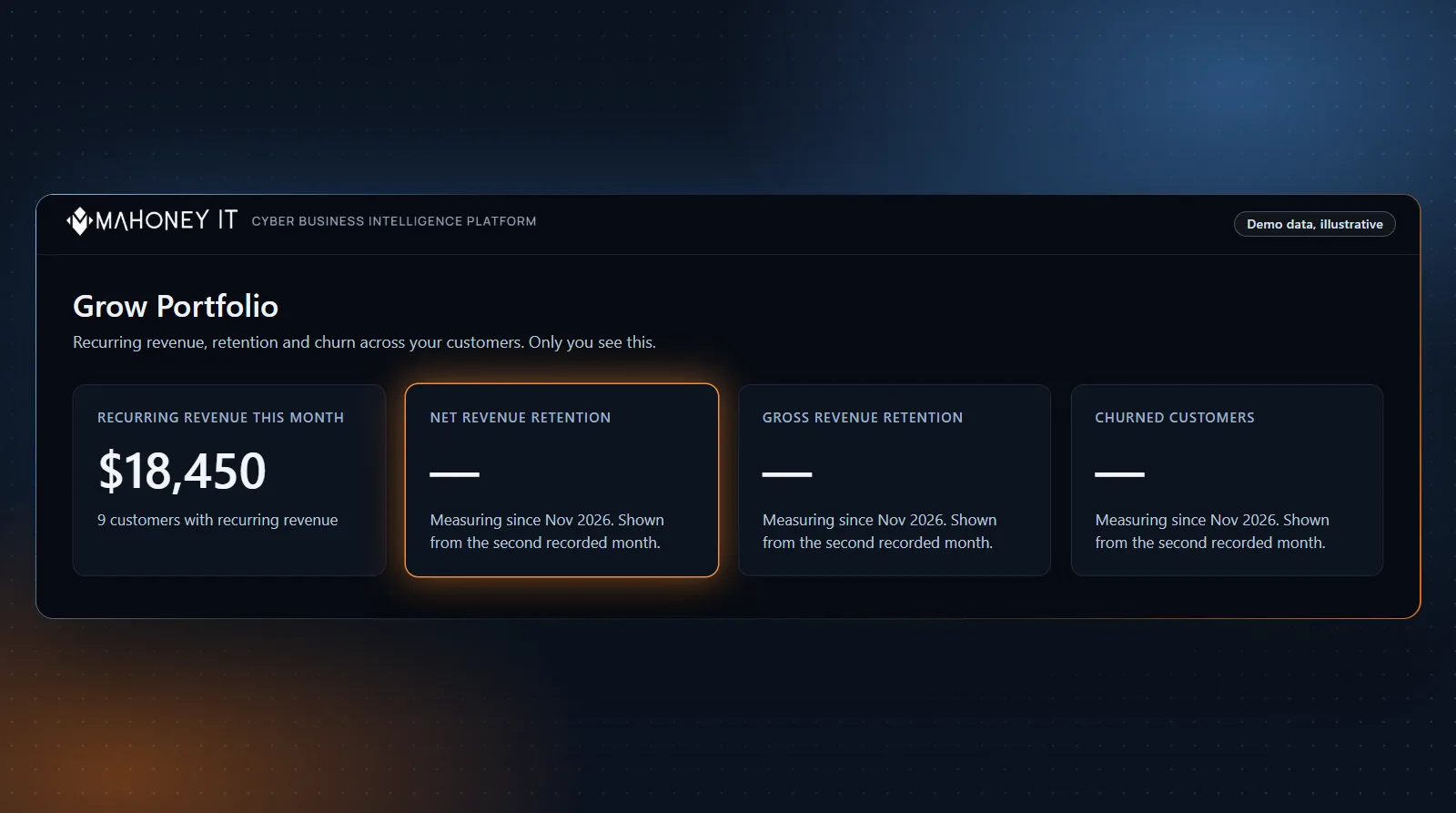
Mahoney Grow, the Growth Intelligence module of Mahoney Control, gives partners a view of some of these commercial signals. The partner view shows monthly recurring revenue per customer, net and gross revenue retention, and churned, shrinking, growing, and new customers. These figures are recorded daily from the sell prices the partner sets, not modeled.
Recording runs from November 2026 with no backfill, so the first retention figure appears in December 2026. A customer with no record for the most recent month is left out of the retention figures and not counted as churned. The same partner view adds margin per customer, from the sell prices you set and the costs recorded, and license utilization for each customer’s own contracts. End customers do not see their partner’s margin.
What the figures mean for a given client, and what to do about it, remains your call.
You can read more on our Growth Intelligence overview. If you’d like to walk through how Mahoney Grow could fit your portfolio, request a no-obligation consultation.
Frequently asked questions
What are the most common signs that an MSP client is about to leave? Signals usually appear in four areas: service quality (rising resolution times, reopened tickets, recurring alerts), commercial changes (removed seats, shrinking recurring revenue, invoice disputes), the relationship (your main contact leaves, reviews get canceled, the client asks about the notice period), and engagement (ticket volume dropping far below the client’s normal). A single signal is a reason to look closer. A pattern across groups deserves a conversation.
How can an MSP reduce client churn? Watch the signals on a fixed cadence, compare each client with their own baseline, and assign an owner to every at-risk account. Fix service problems inside the current agreement and tell the client what you changed. Meet new decision makers before the renewal, and show the value delivered in figures the client can check. Discounts rarely fix a service or relationship problem.
How do you calculate an MSP’s client churn rate? Count the clients who had recurring revenue at the start of a period and have none at the end, divide that count by the number of clients at the start, then multiply by 100. For example, losing 3 of 40 clients in a year gives an annual churn rate of 7.5%, which illustrates the calculation, not a benchmark. Because one large client can outweigh several small ones, track revenue retention alongside the client count.
What is an acceptable churn rate for an MSP? There is no figure we can point to with a method you could check. A more useful benchmark is your own: track client churn and gross revenue retention every month, and judge each against your own previous periods. A churn rate that looks low can still hide a serious revenue loss if the client who left was a large one, which is why both measures belong together.
What is the difference between net and gross revenue retention? Both compare the recurring revenue from the clients you had at the start of a period with what the same clients bring in at the end. Net revenue retention includes growth from those clients, so it can exceed 100%. Gross revenue retention caps each client’s revenue at its starting level, so it shows only what was lost through clients leaving or shrinking. New clients are part of neither.
Is a client who reduces services already churned? No. A client who removes seats or drops a service still has recurring revenue and still counts as a client. The reduction lowers gross revenue retention, and it is often one of the first commercial signals you will see. Ask about the reason before you treat it as routine.
Should one-off service revenue count toward revenue retention? One-off service revenue is better kept apart. Billed project hours and ad hoc service time move with incidents and projects. Mixed into recurring revenue, they make retention rise or fall for reasons unrelated to whether the client is staying.
How do you calculate churn if some months of data are missing? Treat a missing month as unknown, not as a lost client. If the figure is missing for the start or the end of a comparison, leave that client out of both sides of it, and make sure the next month is recorded. Counting a missing month as churn makes the figures worse than reality.
This article is general information on client retention for managed service providers. It does not constitute legal, financial, or accounting advice. Retention and churn figures in the Mahoney Grow partner view are recorded daily from the sell prices the partner sets, not modeled; what they mean for a given client remains a judgment for the partner.
Drafted with AI assistance, checked against our platform and website, and reviewed by Mahoney IT. How we write