Don't Guess Cybersecurity ROI.
Calculate It.
Every cost in your budget has a number — except cyber risk. The Financials module translates your security spend and cyber risk into dollars — counted where possible, modeled where necessary.
All figures in the Financials module are calculated from your own environment. Modeled values are labeled as modeled. Risk and growth models are advisory and do not constitute financial or legal advice.
From Security Spend to Business Case
Four capabilities that turn "what does security cost us?" into a business case for cybersecurity your CFO can actually sign.
Baseline
Four Numbers CFOs Understand
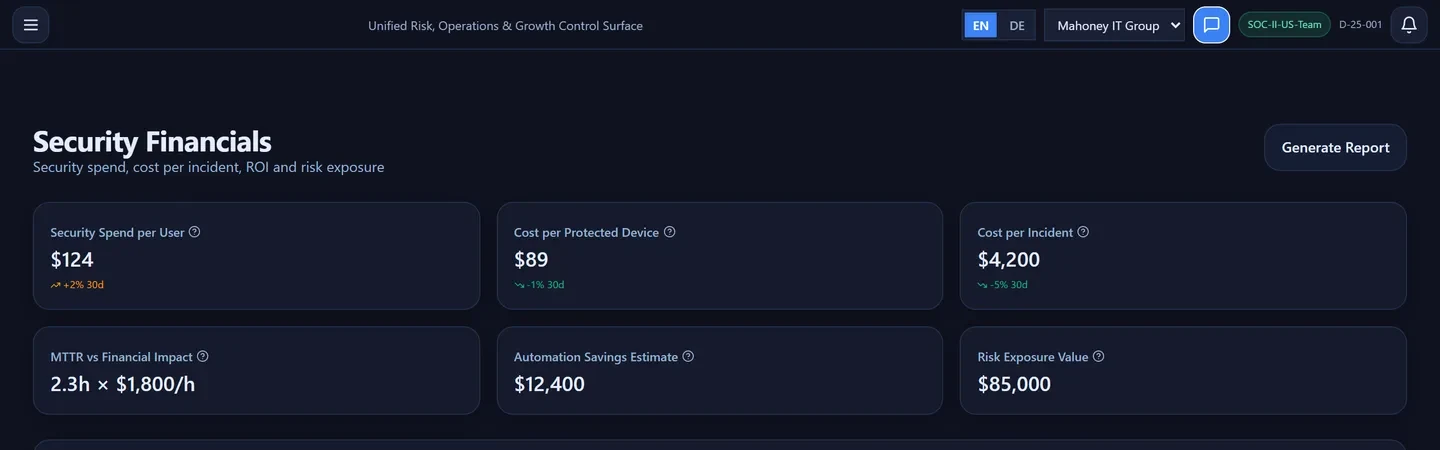
Most security dashboards speak in severities and alert counts. The Financials module opens with four KPIs in plain dollars: Cost per Device, Spend per User, Cost per Incident and Risk Exposure Value. The first three are counted from your real data; the fourth is modeled — and labeled as modeled.
- Cost per Device and Spend per User — counted from your real spend data
- Cost per Incident — your incident economics, not an industry average
- Risk Exposure Value — modeled, and labeled as modeled
Simulation
Two Inputs. One Business Case.
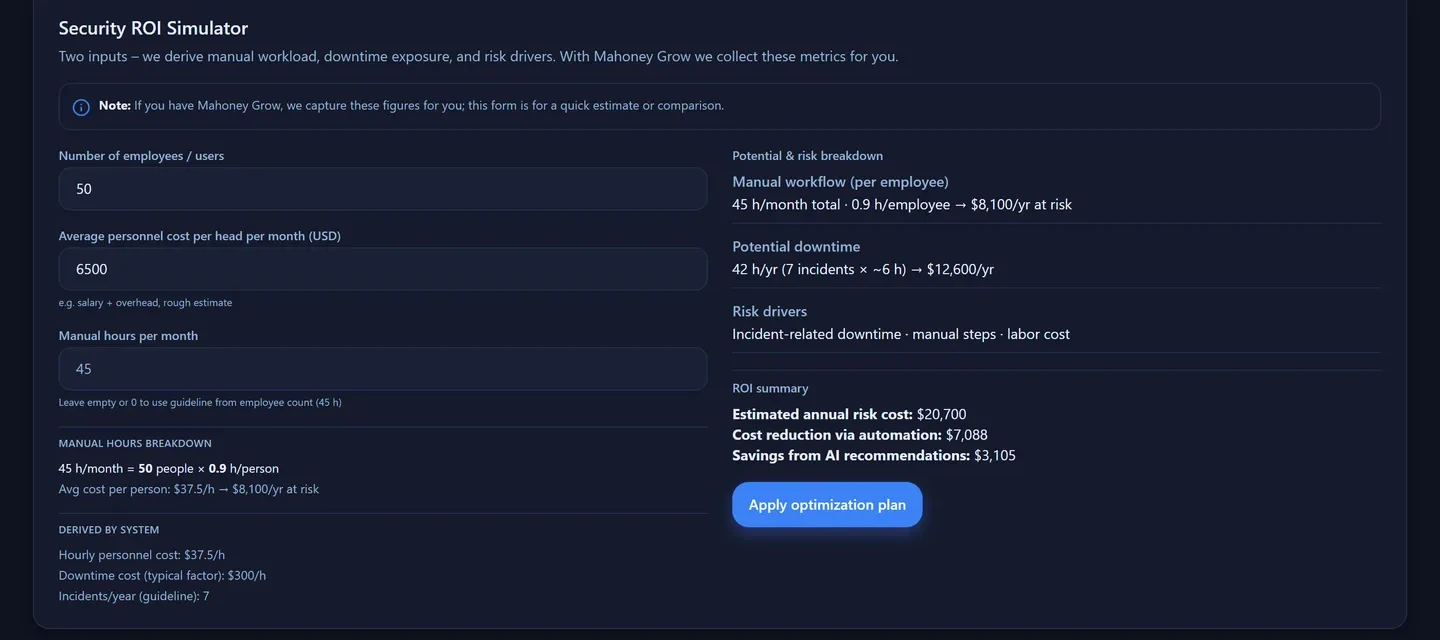
The ROI simulator asks for two inputs and returns a structured business case: projected risk reduction, return on security investment (ROSI) and the assumptions behind both — visible, editable, challengeable. No black box, no vendor math. If your CFO wants to stress-test an assumption, change it and watch the case recalculate.
- Two inputs produce a full, assumption-transparent business case
- ROSI calculated against your spend baseline — not a marketing multiplier
- Every assumption stays visible and adjustable
Quantification
What a Breach Would Cost You
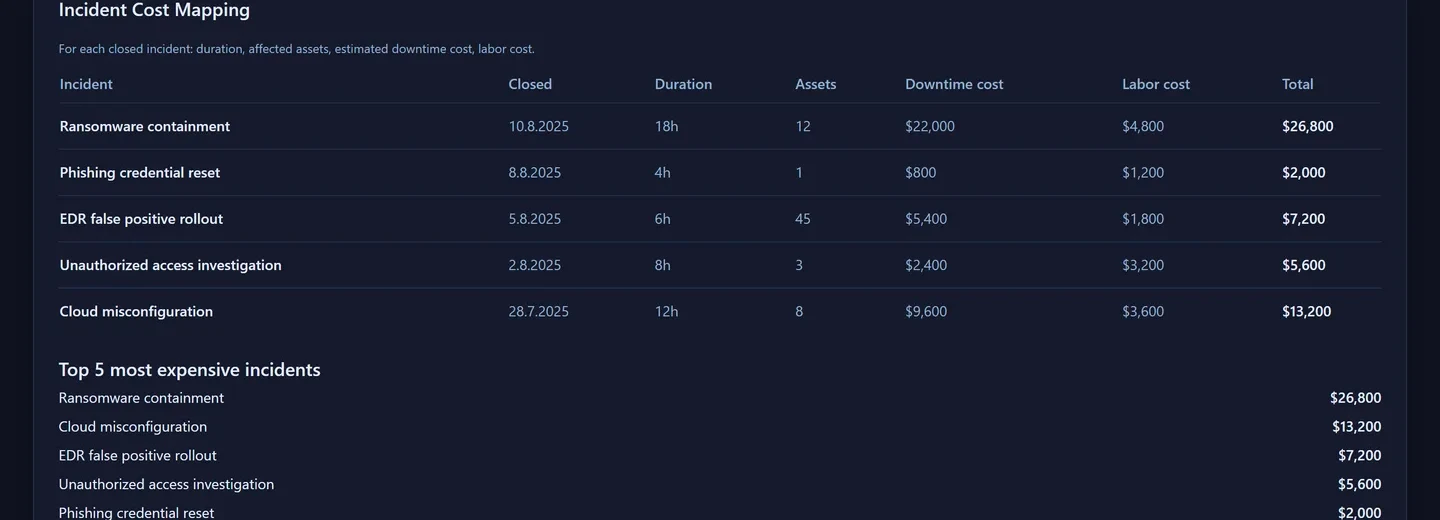
Breach costs from industry reports are someone else's average. Incident Cost Mapping attaches dollar values to your incident classes, and the risk engine quantifies your exposure using the FAIR model — as a range with a confidence band, not false precision. FAIR is a methodology, not a certification; results are advisory.
- Incident classes mapped to dollar impact from your environment
- FAIR-based risk quantification with an explicit confidence band
- A range you can defend — not a point estimate you have to apologize for
Boardroom
From Dashboard to Board Pack
Spend breakdown by connector category shows where your security budget actually goes. Budget planning puts next year's numbers next to this year's reality. When the board meets, one CSV export hands finance the raw data in their own format — no screenshots, no transcription. Your controller can audit every line.
- Spend breakdown by connector category — see where the budget flows
- Budget planning against your real baseline
- Board-ready CSV export — finance audits the raw lines
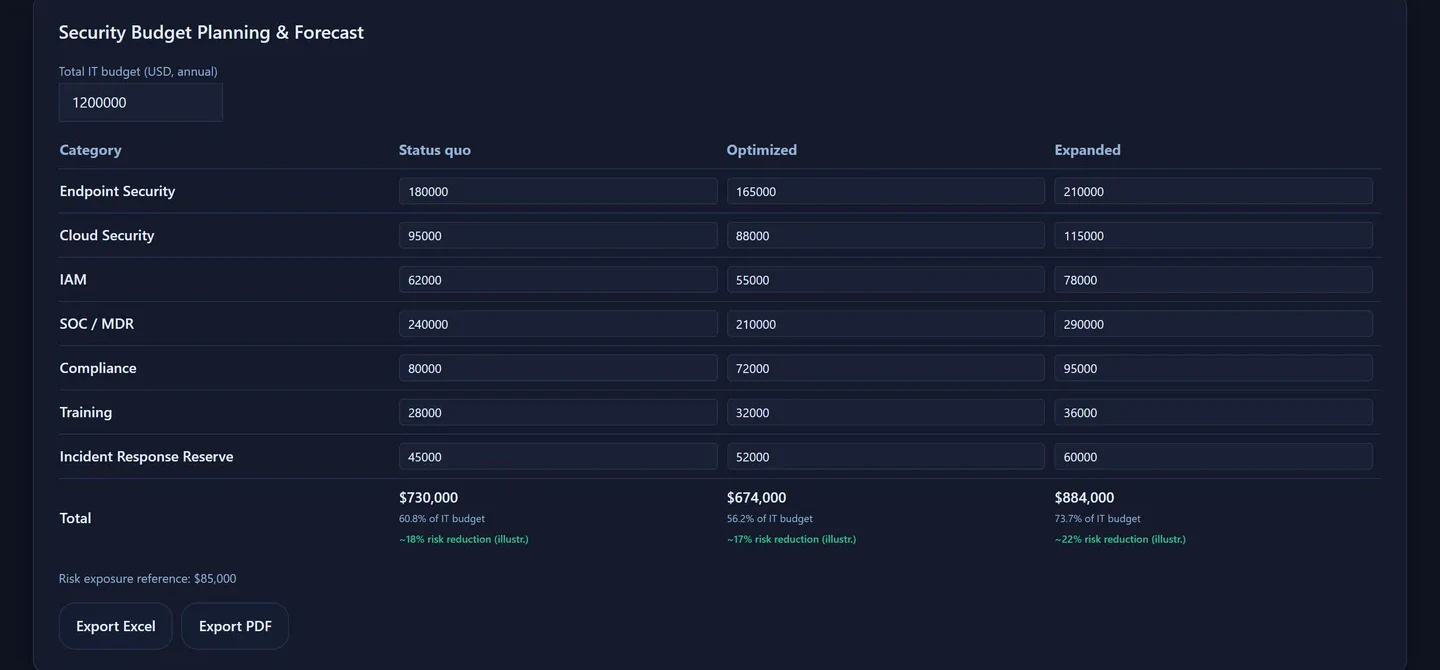
Sample data for illustration purposes — your inputs, your case.

Two Kinds of Numbers. Never One Figure.
Every figure in the Financials module carries one of two labels: REAL — counted from your actual data — or MODELED — estimated from stated assumptions. The platform refuses to add the two into one impressive headline number, because a blended figure is how security ROI gets oversold. If a number on screen is an estimate, it says so — and that extends to derived values: if an estimated input goes into a calculation, the result carries that label. That is the entire trust model — and the reason a CFO can take these numbers into a board meeting.
All values in the Financials module are calculated from your environment. Modeled values are labeled as modeled. Risk and growth models are advisory and do not constitute financial or legal advice.

From Spreadsheet to Boardroom
From an Act of Faith to a Line Item.
Operations runs your security operations. Governance maps your controls. Growth Intelligence finds the upside. Financials is where all of it lands on one page in one currency — the security posture of your company, expressed in numbers your board already knows how to read. Same Mahoney Control instance, same telemetry, same opt-in principle.
Talk to a Mahoney IT SpecialistSpreadsheet Guesswork vs. Quantified Risk
Your CFO has a value for every risk in the company — except one. Cyber risk is the number that isn't on your balance sheet.
Budget Defense by Gut Feeling
Industry Averages as Arguments
The breach-cost figure in the budget deck comes from a vendor report about other companies. The CFO knows it — and discounts it accordingly.
One Blended ROI Number
Counted savings and estimated risk get added into a single impressive figure. It survives exactly one follow-up question.
Cyber Risk Missing from the Books
Every other business risk has a value attached. Cyber risk shows up as a tool list and a feeling — so the budget gets defended, never approved with conviction.
Renewal Time Means Starting Over
Every budget cycle rebuilds the same spreadsheet from scratch, with numbers nobody can trace back to source.
A Business Case in Your Own Numbers
Your Environment, Your Economics
Cost per device, spend per user, cost per incident — counted from your actual data, not borrowed from a report about someone else.
Real and Modeled, Kept Apart
Counted figures and estimates never blend into one headline. Every number survives the follow-up question — because its label already answered it.
Risk as a Range, Not a Guess
FAIR-based cyber risk quantification with a confidence band puts a defensible dollar range on your exposure. Advisory, transparent, challengeable.
A Standing Business Case
The ROI simulator and CSV export mean next quarter's budget conversation starts from live numbers — risk reduction against spend, not memory against opinion.
FAIR is an analysis methodology applied by the platform, not a certification. Risk and growth models are advisory and do not constitute financial or legal advice.
Financials — Frequently Asked Questions
How do you calculate cybersecurity ROI?
What is a good ROI for cybersecurity?
How do I justify the security budget to the board?
What is the cost of a data breach?
What is cyber risk quantification (CRQ)?
How is ROI measured honestly?

Your data stays yours · Security operations since 2018 · Data residency EU / US / Asia — your choice · Your tools stay yours
ISO 9001:2015 certified by DEKRA (Germany) · 24/7 SOC operations · Four modules, one platform
See Your Security Spend in a New Currency
30 minutes. No sales pitch — just an honest look at how the Financials module turns your security spend and your cyber risk into numbers your board can act on.
Mahoney Control maps controls to ISO 27001 · SOC 2 Type II · NIS 2 · NIST CSF
Framework mapping supports your audit preparation — certification itself is awarded by independent auditors. All figures in the Financials module are calculated from your environment; modeled values are labeled as modeled. Risk and growth models are advisory and do not constitute financial or legal advice.