How to show clients the value of cybersecurity, in dollars they can check
How MSPs and MSSPs can show clients security ROI with figures finance can check, keeping counted and modeled numbers apart.
- A client's owner or board reads dollars, not severities. If your security report never reaches a dollar figure, the only number the client remembers is your invoice.
- Every dollar figure is either counted or modeled. Keep the two labeled and apart, because one blended ROI number doesn't survive the first follow-up question.
- Credibility comes from the client's own numbers and visible assumptions, not from industry averages about other companies.
In this article
- Why the value of cybersecurity is so hard to show
- What “security ROI” can honestly mean for an MSP
- Start with the numbers you can count
- Value the client already has to prove
- Then model what you have to, and say so
- Five ways the business case gets oversold
- Make it a standing conversation, not a renewal-season project
- A one-page agenda for the next quarterly review
- How Mahoney Control puts security spend and risk in dollars
- Frequently asked questions
There is a moment every managed service provider knows. The renewal is on the table, the client’s finance lead is going down the vendor list, and someone asks the question that sounds simple: what are we actually getting for this?
The honest answer is awkward. When cybersecurity works, nothing happens. No outage, no ransom note, no call from a customer whose data leaked. Success is an absence, and an absence is very hard to put on an invoice. So the conversation drifts toward what can be shown: tickets closed, patches deployed, alerts handled. All of that is real work. None of it is a number a CFO can weigh against your fee.
This article is about how to show clients the value of cybersecurity with figures you can defend. It is written for managed service providers (MSPs) and managed security service providers (MSSPs) who report to clients, and it is deliberately strict about one thing: the difference between a number you counted and a number you modeled.
Why the value of cybersecurity is so hard to show
Three things work against you, and none of them is the quality of your service.
- Success is invisible. A blocked attack leaves a log line, not a story. The client experiences a quiet quarter and concludes that maybe there was nothing to stop.
- Security reports speak the wrong language. Severities, alert counts, and patch compliance describe your security measures well enough for a technician. To an owner or a board they read as activity, and activity is a cost.
- The people who approve the budget think in dollars. Every other risk in the business has a value attached: inventory, receivables, insurance, and legal exposure. Cyber risk shows up as a tool list and a feeling, so the cybersecurity budget gets defended instead of approved.
The result is predictable. Cybersecurity becomes a line item that gets cut when margins tighten, and your service is judged on price because nothing else is on the page.
What “security ROI” can honestly mean for an MSP
Return on security investment, often shortened to ROSI, sets the expected reduction in risk against what the cybersecurity measures cost. The idea is sound. The trouble starts when the inputs come from somewhere the client doesn’t recognize.
Before you put any dollar figure in front of a client, ask which of two kinds it is:
| Counted (real) | Modeled (estimated) | |
|---|---|---|
| Where it comes from | The client’s own data: spend, devices, users, recorded events | Assumptions you and the client state openly |
| Example | Security spend per device | The average cost of an incident in this business |
| What it can claim | ”This is what happened" | "This is what it would mean, if the assumption holds” |
| How it should be labeled | Counted | Modeled |
Both kinds belong in a business case. What doesn’t belong there is a single headline figure that quietly adds the two together. A blended number looks impressive in the first meeting and doesn’t survive the first follow-up question. It also hands the client’s finance team a reason to discount everything else you show them.
Start with the numbers you can count
The safest ground is the client’s own spend, taken from invoices finance already recognizes.
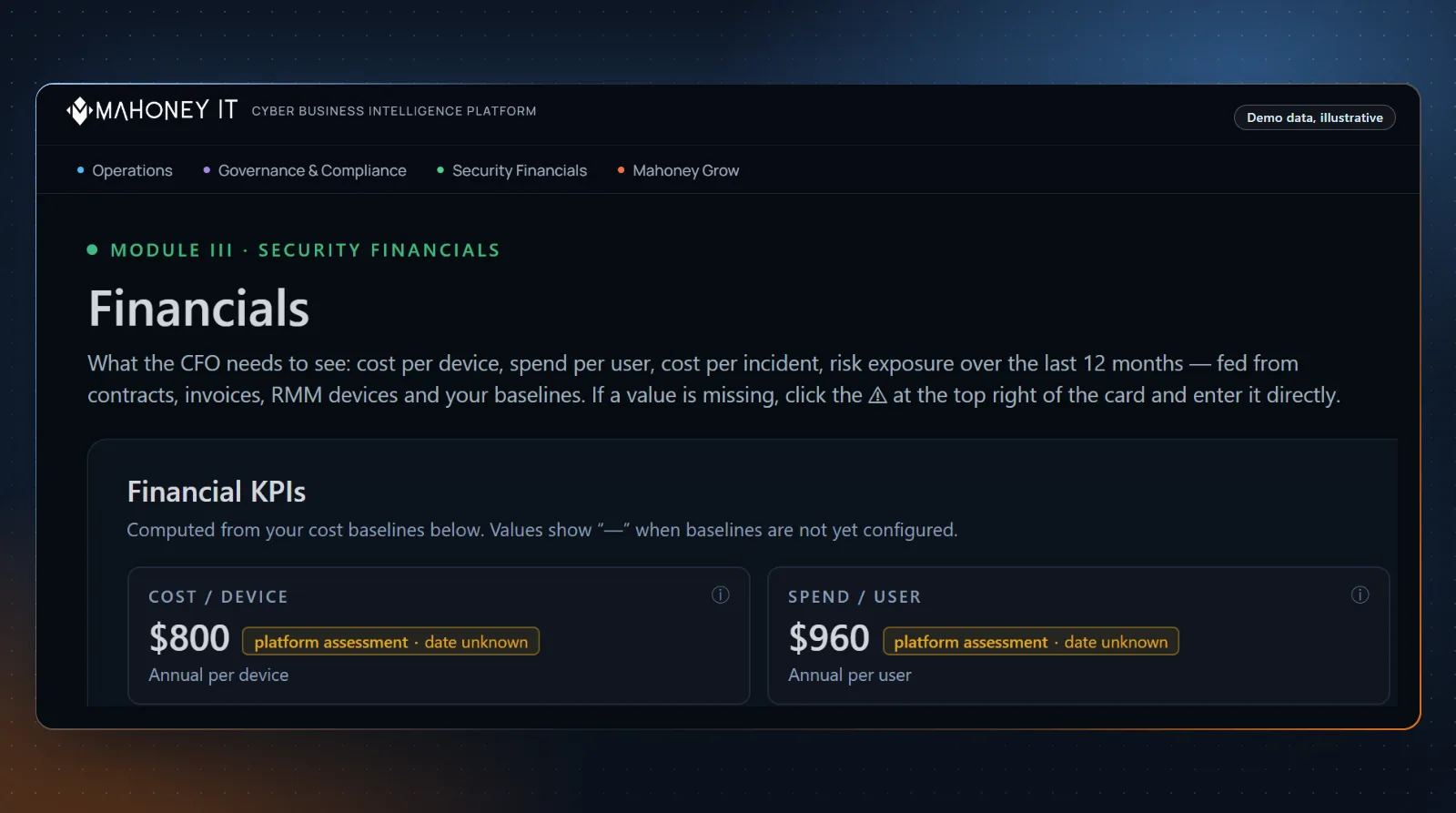
- Cost per device. Total security spend divided by the devices in scope. It turns a lump-sum invoice into a unit price the client can compare from one year to the next.
- Spend per user. The same spend, divided by the people it protects. For many owners this is the more intuitive figure, because headcount is what they plan around.
- Spend breakdown by category. How the spend divides across tool categories, such as endpoint protection, monitoring, and email security. A split like this is an allocation rather than invoiced cost, so say so. The split can be surprising, and that surprise starts a better conversation than any slide about cyber threats.
These figures don’t prove that cybersecurity pays off. They do something more useful first: they make the spend legible. A client who understands what a protected device costs is ready to talk about what an unprotected one could cost.
One honest caveat: a per-device figure invites a price comparison. Someone will hold it against a cheaper quote that covers far less. Show it next to the scope of service it pays for, never on its own.
Value the client already has to prove
Not all of the value is hypothetical. Many clients already have to demonstrate their security to someone else, and your work is what lets them answer.
- Insurers. Cyber insurance applications and renewals typically ask about controls such as multi-factor authentication, backup, and endpoint protection. Answers the client can’t support with evidence may be questioned when a claim is made.
- The client’s own customers. Larger customers send security questionnaires before they sign or renew. We cover how to answer one in our guide to the vendor security questionnaire.
- Contracts. Customer contracts often carry obligations to protect data or report incidents. Meeting them is part of keeping the contract.
None of this needs a model. It is value the client can see in their own paperwork, and it is often the easiest place for an owner to start.
Then model what you have to, and say so
Risk can’t be counted in advance. The financial impact of an incident has to be modeled, and the model is only as credible as its assumptions.
Agree on the cost of an incident with the client, not for them. What does a day of downtime cost this business? How many hours of response effort does a serious event take? What notification or contractual obligations follow a data breach? The client knows their own economics better than any report does. An average cost per incident that the client helped set is one they can defend in front of their own owner or board.
Keep the exposure formula simple. A transparent way to express risk exposure is the average cost per incident multiplied by the number of error and critical events recorded in the environment over the last 12 months. Here is a hypothetical example, for illustration only: if the agreed average is $25,000 per incident and four such events were recorded in those 12 months, the exposure figure is $100,000.
Be precise about what that figure is. Read it as a rough model under its own assumptions: it assumes every one of those events would have become a full incident at the agreed average cost, and it says nothing about what was never recorded at those levels. It can run high or low, so it isn’t a maximum. It is not money saved, and it is not an expected loss. It is also not a forecast or an annualized loss expectancy (ALE): it rests on what was recorded, and predicting a loss needs an assumption about how often real incidents occur, which the count doesn’t contain. If you make that assumption, state it.
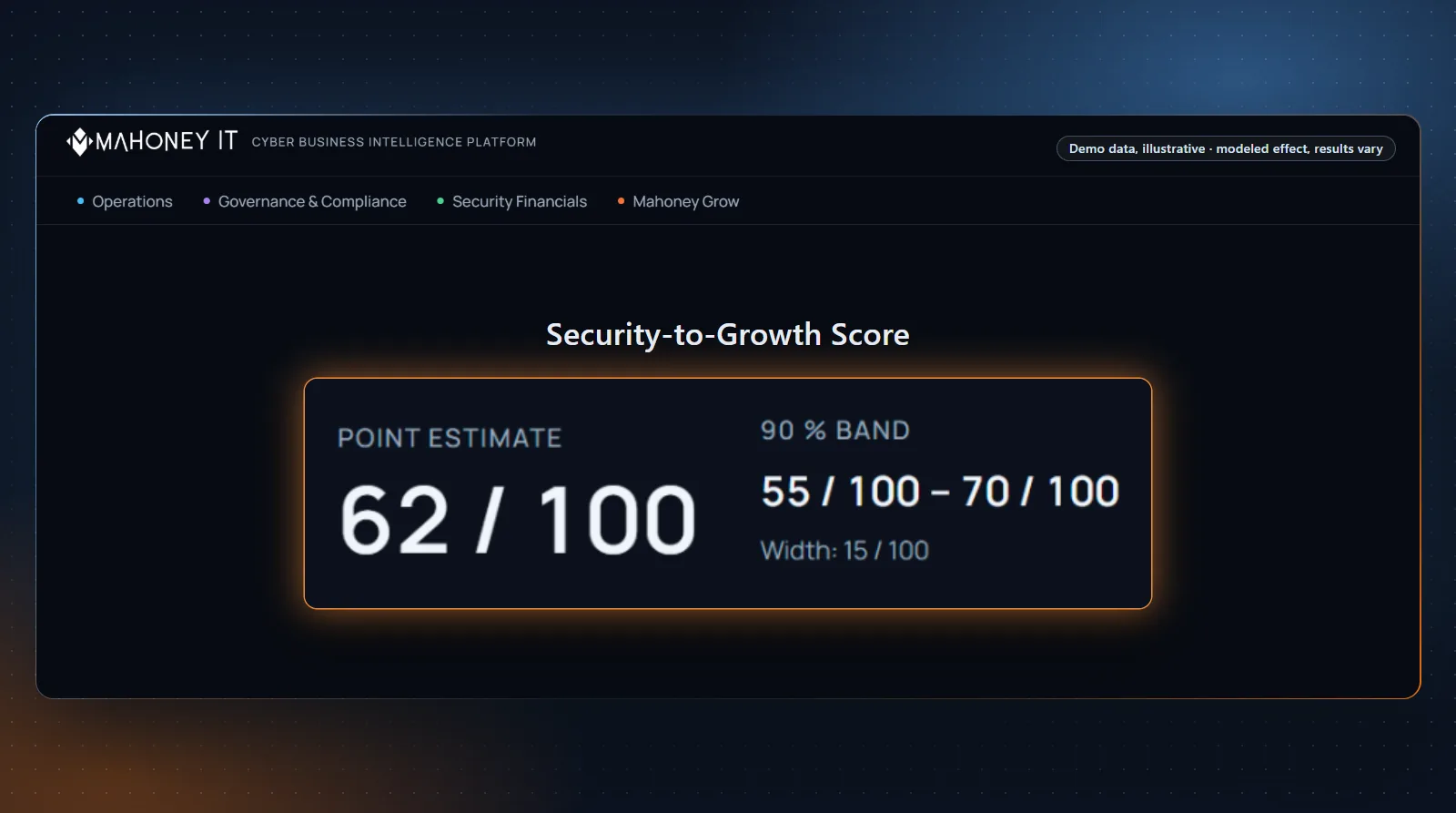
Take the step from exposure to ROSI in the open. Continuing the hypothetical example: the client considers a measure that costs $15,000. The client’s team then sets how much of the exposure they believe it would remove. Assume, for illustration, 50 percent. The projected risk reduction is $50,000, and ROSI is ($50,000 − $15,000) ÷ $15,000, roughly 2.3, or about 233 percent. Every input in that line is either the client’s own figure or a labeled assumption, so the result is a modeled figure too. Because it starts from the exposure figure, it carries the same limits, and it is not an expected return. Make sure the cost and the exposure cover the same period, and if they don’t, name the assumption that bridges the gap.
Show the assumptions, and let the client change them. If the CFO thinks your incident average or the assumed reduction is too high, lower it in front of them and let the case recalculate. A business case that survives its own stress test is worth more than one that has to be taken on faith.
Five ways the business case gets oversold
Most credibility problems in client reporting come from the same few habits.
- Borrowing industry averages. A data breach cost figure from a vendor report describes other companies. The client’s CFO knows it and discounts it accordingly. If an outside figure is ever used, it should come from a named primary source and be labeled as someone else’s number.
- Blending counted and modeled figures. Counted savings plus estimated risk avoided, added into one total. It reads well and explains nothing.
- Turning a count into a forecast. Recorded events from a past period, presented as expected annual loss. The number is easy to quote; the claim behind it is not supported.
- Presenting the exposure figure as dollars saved. The exposure figure above is a rough model under its own assumptions. Calling it savings claims that every recorded event would have become an incident, and nobody can say which ones would have.
- Hiding the assumptions. A result without visible inputs asks the client for trust at exactly the moment you are trying to earn it.
Notice that none of these is a calculation error. Most are labeling errors: a modeled number presented as if it had been counted.
Make it a standing conversation, not a renewal-season project
The worst time to build a security business case is the week before the renewal meeting, from a spreadsheet nobody can trace back to its source. The case is far stronger when it is current every time the client looks at it.
- Review the figures on a regular cadence, so the numbers in the renewal conversation are ones the client has already seen and questioned.
- Put the budget plan next to invoiced actuals. Budget planning against the client’s own baseline turns “we need more” into “here is what changes, and what it costs.”
- Hand finance the numbers behind the report. An export in a format the client’s controller can open and check does more for trust than a polished screenshot.
A one-page agenda for the next quarterly review
- Spend per device and per user, compared with the previous quarter, with a sentence on what changed and why.
- Three questions to confirm the cost of an incident: What does an hour of downtime cost the business today? How much response effort does a serious event take? Which notification or contractual obligations would follow?
- The exposure figure, labeled as a model, with its assumptions on the same page.
- One proposed change and its effect: what it costs, what risk reduction the client assumes for it, and what that means for the modeled risk and the ROSI.
Over time, this shifts the relationship. You stop defending a cost and start reviewing a set of numbers together, with the client’s finance team as a participant rather than an audience.
How Mahoney Control puts security spend and risk in dollars
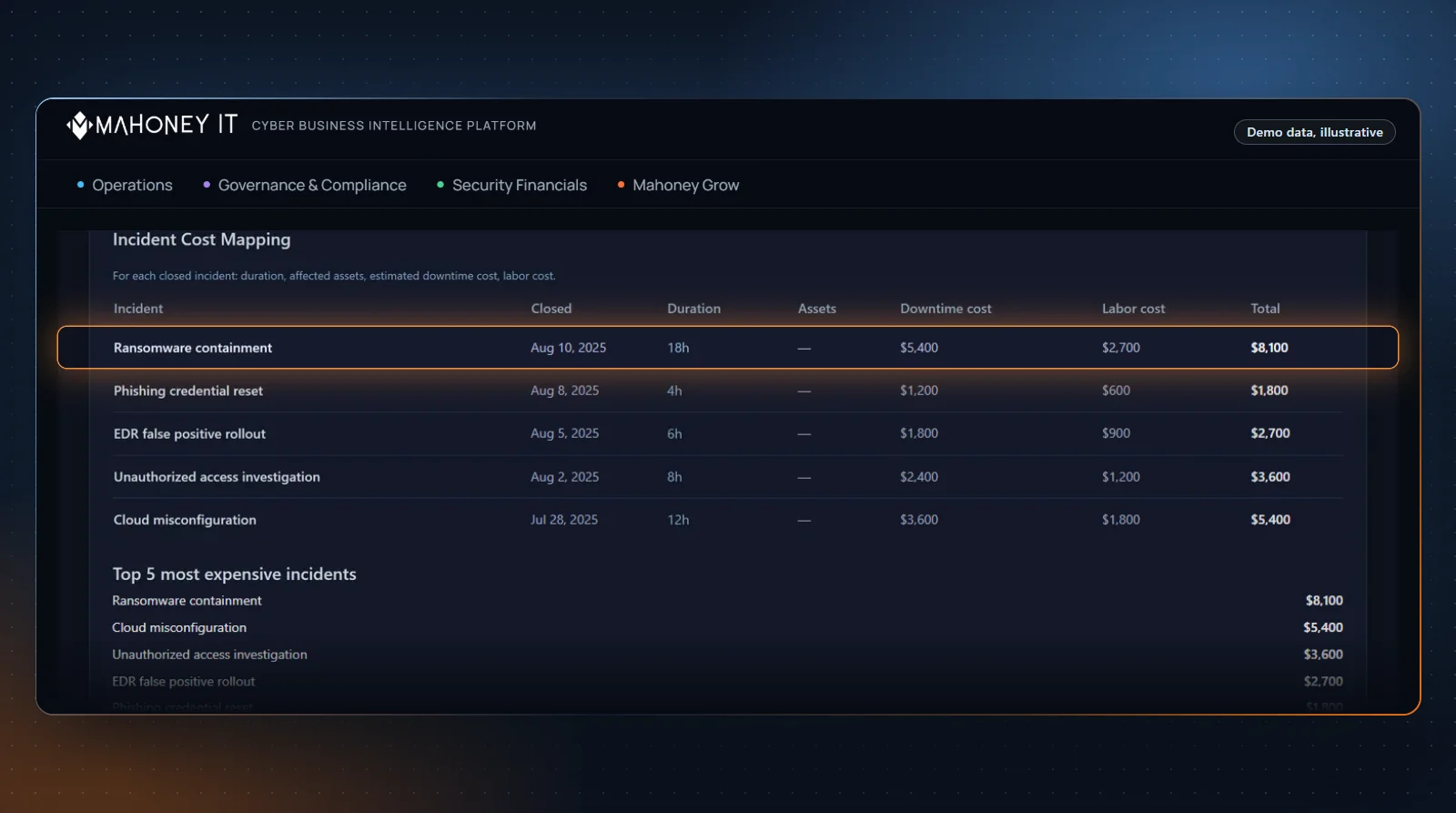
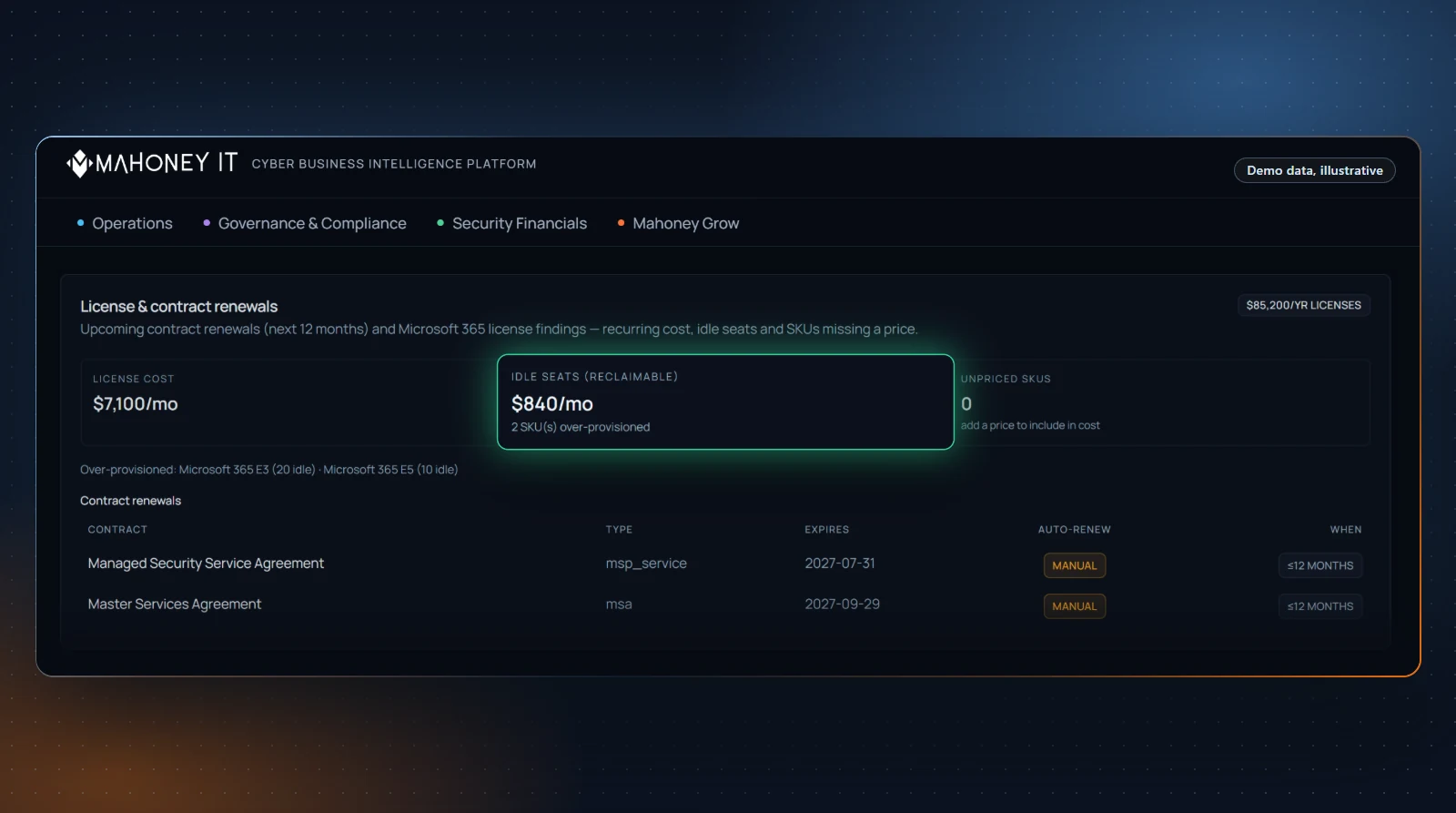
We built the Financials module of Mahoney Control for this conversation. It is designed to show these figures in dollars: spend per user, cost per device, cost per incident, and risk exposure. Incident Cost Mapping attaches estimated dollar values to recent closed incidents, or marks them as included on a flat retainer, and the ROI simulator turns a few inputs into a return-on-security-investment case measured against the spend baseline, with its assumptions visible and adjustable. Spend breakdown by connector category, budget planning, and a CSV export for finance round out the module.
The counted-versus-modeled discipline in this article is a way of presenting numbers, and it stays your call. Before a figure goes in front of a client, check the cost values behind it, replace the default downtime and labor rates with the ones you agreed on with the client, and say which figures are counted and which are modeled.
Mahoney Control is multi-tenant: MSPs and MSSPs run each client in its own tenant, with strict tenant isolation per client. Each client’s figures are calculated from that client’s own environment, the values set for it, and platform defaults, never from another client’s data. You can read more on our Financials overview.
If you’d like to see how the Financials module would present spend and risk for the clients in your own portfolio, request a no-obligation consultation.
Frequently asked questions
How do I show clients the value of cybersecurity when nothing happened? You can’t prove a counterfactual, and claiming dollar savings from blocked attacks invites the obvious question of which ones would have caused damage. What you can show is what the protection costs per device and per user, what the client already has to prove to insurers and customers, and under their contracts, and what an incident would cost the business under assumptions the client agreed to. Label that last figure as modeled, not as money saved.
How do MSPs calculate security ROI for a client? Start from the client’s own spend to get counted figures such as cost per device and spend per user. Then agree on an average cost per incident with the client and model risk exposure from it, labeling that figure as modeled. Return on security investment (ROSI) sets the projected risk reduction of a measure against its cost; the reduction is an assumption the client sets, so the result is modeled too and its inputs should stay visible.
Should I use industry breach-cost averages in client reports? Use them sparingly, if at all. An average describes other companies, and a client’s finance team will discount it. If you do quote an outside figure, name the primary source and keep it clearly separate from the numbers that come from the client’s own environment.
Is risk exposure the same as a predicted annual loss? No. A risk exposure figure calculated as the average incident cost times the error and critical events recorded over the last 12 months is a rough model, because it assumes every event became an incident and it can run high or low. An annualized loss expectancy (ALE) needs an additional assumption about how often incidents occur per year, so the figure shouldn’t be presented as one without stating that assumption.
What should a client security report include for the owner or board? What cybersecurity costs today, broken down by category and per device or user; what the client’s risk is worth in dollars, labeled as modeled; and what a proposed change would do to both, with the assumptions shown. Add the figures and their assumptions in a format finance can check, so the owner or board reviews numbers rather than claims.
Who should set the average cost per incident? The client, with the MSP’s help. The MSP brings the structure: downtime, response effort, and obligations that follow an incident. The client brings the economics of their business. An average cost per incident the client set is one they can defend themselves.
This article is general information on presenting security spend and cyber risk in financial terms. It does not constitute financial, legal, or insurance advice. Example figures are hypothetical and for illustration only. Values in the Mahoney Control Financials module are calculated from the environment, the values set for it, and platform defaults. Risk models are advisory.
Drafted with AI assistance, checked against our platform and website, and reviewed by Mahoney IT. How we write