How 24/7 cybersecurity monitoring works
24/7 cybersecurity monitoring watches your systems around the clock for threats — not just 9 to 5. Here's how continuous security monitoring works and why it matters.

- 24/7 cybersecurity monitoring — also called continuous security monitoring — watches your systems, network, and cloud around the clock for cyber threats, so attacks are caught whenever they happen, not just during office hours.
- Most of the week sits outside business hours, and attackers know it: nights and weekends are prime time for ransomware and intrusions, exactly when in-house teams are offline.
- Real coverage takes automation and people. Most growing businesses get it through a managed SOC (SOC as a service) rather than building a night shift of their own.
In this article
- What is 24/7 cybersecurity monitoring?
- Why business-hours monitoring isn’t enough
- What 24/7 monitoring covers
- What threats it detects
- How continuous monitoring works
- Automation and analysts — why you need both
- Cyber insurance and compliance
- Doing it in-house vs. through a managed SOC
- How Mahoney Control delivers 24/7 monitoring
- Frequently asked questions
“We’re monitored.” It’s one of the most comforting sentences in security — and one of the most misleading. Monitored by what, exactly? And watched by whom at 3 a.m. on a holiday weekend? A stack of tools quietly logging alerts into an empty room isn’t being watched — it’s just record-keeping.
24/7 cybersecurity monitoring is the part most setups skip: someone — and something — actually watching, every hour of every day, ready to act. This guide explains what that really means, how continuous monitoring works, and how to get it without standing up a night shift of your own.
What is 24/7 cybersecurity monitoring?
24/7 cybersecurity monitoring is the continuous watching of your IT environment — endpoints, network, cloud, and identities — for signs of a cyberattack, every hour of every day. “24/7” means exactly that: around the clock, including nights, weekends, and holidays. You’ll also hear it called continuous security monitoring.
The word that matters is continuous. It takes two things working together: automated tools that collect and analyze signals without pause, and SOC analysts who investigate and act on what surfaces. Catching a problem as it happens, not finding it in a log weeks later, is the whole point — proactive detection and response, not after-the-fact cleanup. Monitoring that runs only during office hours, or that just collects logs nobody reads until something breaks, isn’t continuous security monitoring.
Why business-hours monitoring isn’t enough
Here’s the uncomfortable math. A 9-to-5, five-day week is about 40 hours. A full week is 168. That leaves roughly three-quarters of every week — evenings, nights, and weekends — with no one watching.
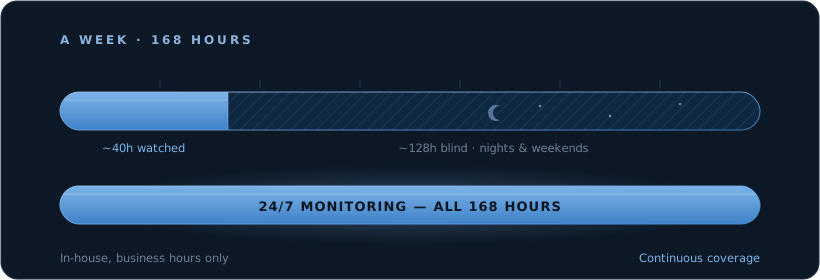
Attackers live in that gap on purpose. Ransomware is routinely timed for nights, weekends, and holidays, when the response will be slowest. The longer an intrusion goes unnoticed — its “dwell time” — the more it can do: steal data, spread across systems, and disable backups before anyone logs in on Monday. A contained alert becomes a full-blown breach. The sooner one is caught, the less it tends to cost — which is the entire argument for closing the gap.
What 24/7 monitoring covers
Real coverage watches your whole environment, not one corner of it: endpoints (laptops and servers, via EDR), network traffic (lateral movement, data leaving the building), cloud and SaaS, identity and access (suspicious logins, privilege changes), and the logs and events pulled together in a SIEM. The value isn’t watching any one of these — it’s correlating them, so a strange login, an endpoint alert, and an odd network flow connect into a single picture instead of three alerts nobody links. That continuous, correlated view is what makes early threat detection possible across your whole security posture.
What threats it detects
Continuous monitoring catches the full range — ransomware, phishing and account takeover, advanced persistent threats (APTs) that hide in normal activity, data breaches, insider misuse, and the quiet anomalies of someone probing an unpatched vulnerability. The difference 24/7 makes isn’t what it catches but when: while an attack is still small, at 3 a.m. on a holiday — not in the post-mortem. (For how a SOC turns those signals into action, see what a managed SOC does.)
How continuous monitoring works
Under the hood, 24/7 monitoring runs as a constant loop: collect signals from every system → analyze and correlate them to spot anomalies → alert and triage out the noise → respond to contain and recover — then straight back to the start, without pause.
Automation handles the impossible volume and flags what looks wrong in real time, drawing on threat intelligence about the latest attacks. When something genuine surfaces, it’s triaged, and if it’s real, an incident response begins. The point of “continuous” is that there’s no overnight pile-up of unread signals — the loop never stops, because attackers don’t either.
Automation and analysts — why you need both
Plenty of vendors will sell you monitoring that’s really just software. It isn’t enough on its own.
Automation never sleeps: it watches the constant stream, applies detection rules and threat intelligence, and surfaces anomalies far sooner than a person could. But real attacks are ambiguous, and a tool that can’t tell a true threat from a false alarm just generates more noise. That’s where people come in — SOC analysts investigate the unclear cases, hunt for what slips past the rules, and decide how to respond. Automation without judgment floods you with alerts; judgment without automation can’t keep up. Genuine 24/7 monitoring is both.
Cyber insurance and compliance
Continuous monitoring has quietly moved from “nice to have” to “expected.” Cyber-insurance applications increasingly ask whether you have around-the-clock monitoring and detection, and the answer can affect your eligibility and your premium. Compliance and audit programs — demonstrating due diligence for frameworks such as SOC 2, HIPAA, or PCI DSS — expect evidence of continuous monitoring and a documented incident response too. (Certification under any of these is awarded by independent auditors; monitoring is one piece of the evidence they look for.) Underneath the box-ticking, it’s the same thing that genuinely strengthens your security posture: being able to show, at any moment, that your environment is watched and that you can act on what’s found.
Doing it in-house vs. through a managed SOC
This is where most growing businesses hit a wall. Covering every hour of every day, with no gaps, takes far more than one or two people:
| What true 24/7 coverage needs | In-house | Managed SOC (SOCaaS) |
|---|---|---|
| Analysts to cover all shifts, year-round | ~5+ full-time hires | Included in the service |
| Monitoring tools (SIEM, EDR, threat intel) | Buy, integrate, maintain | Provided and tuned |
| Holiday / sick / turnover cover | Your problem | The provider’s problem |
| Who acts on a 3 a.m. alert | Your on-call, if anyone | The SOC team |
| Cost model | Large, fixed payroll | Predictable subscription |
That’s why most companies don’t build their own night shift. They get 24/7 monitoring through a managed SOC — a security operations center delivered as a service, where the coverage, tools, and people come as one package. A managed SOC also goes further than a basic MSSP, which forwards alerts but doesn’t always investigate or respond.
How Mahoney Control delivers 24/7 monitoring
“Monitored” should mean you can see it — not take it on faith.
Mahoney Control — by Mahoney IT — watches your environment continuously and brings every signal onto a single surface. Instead of separate, unwatched consoles for endpoint, network, cloud, and identity, the platform correlates those signals in real time, applies automated analysis to surface what matters, and keeps the supporting evidence in one place — with SOC analysts who investigate and respond to what it finds. The result is monitoring you can actually look at and audit, rather than a black box that promises someone, somewhere, is paying attention. If your business holds sensitive data, can’t afford downtime, or carries compliance or cyber-insurance obligations, that visibility is the difference between hoping you’re covered and knowing it.
You can read more on our Security Operations page.
Frequently asked questions
What does 24/7 cybersecurity monitoring include? Continuous collection and analysis of signals from your endpoints, network, cloud, and identities, plus the triage and incident response that turns those signals into action — every hour of every day.
How much does 24/7 cybersecurity monitoring cost? It depends on the size of your environment, how much it generates, and how much of the response you hand over. Through a managed SOC it’s a predictable, recurring service — usually far less than hiring and running an around-the-clock team in-house.
Is 24/7 monitoring worth it? For any business that holds valuable data or can’t afford downtime, usually yes. A single ransomware incident or data breach tends to cost far more than continuous monitoring — and insurers and auditors increasingly expect it anyway.
Is 24/7 monitoring the same as a managed SOC? Not quite. Monitoring is one core function; a managed SOC is the full security operations capability — monitoring, detection, triage, and response — delivered as a service. 24/7 monitoring is its foundation.
Can cybersecurity monitoring be fully automated? No. Automation does the heavy lifting, but real attacks need human judgment to investigate and respond. Genuine 24/7 monitoring pairs automation with analysts.
If you’d like to see what around-the-clock monitoring would look like for your organization, request a no-obligation security assessment.