How alert triage works
Security alert triage turns thousands of daily alerts — most of them false positives — into the few that matter. Here's how triage works and beats alert fatigue.

- Security alert triage is the work of sorting a flood of security alerts — most of them false positives — to find the few that are real and urgent, then deciding what to do about each.
- The danger isn't too few alerts; it's too many. Alert fatigue means real attacks get missed in the noise, which is why triage is the make-or-break step in detection.
- Good triage blends automation — deduplicating, enriching, and prioritizing alerts — with human judgment for the ambiguous cases, turning a noisy queue into clear decisions.
In this article
- What is alert triage?
- The real problem: alert overload and alert fatigue
- The alert triage process: step by step
- False positives vs. false negatives
- Who performs triage in a SOC?
- Automation and analysts: who does what
- Measuring triage: the metrics that matter
- How to cut alert fatigue
- Doing triage in-house vs. through a managed SOC
- How Mahoney Control approaches alert triage
- Frequently asked questions
Ask a stretched security team what keeps them up at night, and it’s almost never “we don’t get enough alerts.” It’s the opposite: thousands of alerts a day, the vast majority false alarms, and the quiet fear that the one that actually mattered is buried somewhere in the pile.
Alert triage is the work of finding it. It’s the unglamorous, decisive step that separates a security operation that protects you from one that just generates noise — and it’s where most setups quietly fall down.
What is alert triage?
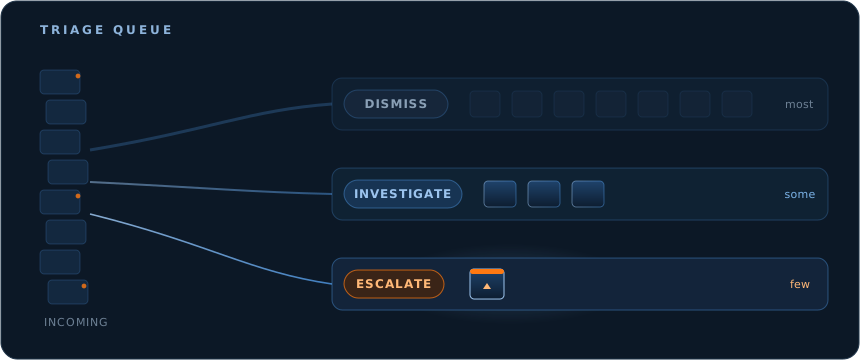
Security alert triage is the process of reviewing incoming security alerts, separating real threats from false alarms, and deciding what happens to each one — dismiss it, investigate it, or escalate it as an incident. Borrowed from the emergency-room sense of the word, it’s about putting limited attention where it matters most, fast.
It sits in the middle of threat detection: tools generate the alerts, triage decides which ones are worth a human’s time, and response acts on the ones that are. Without triage, detection just produces a longer list nobody can act on.
The real problem: alert overload and alert fatigue
Here’s the uncomfortable truth about modern security tooling: it’s very good at generating alerts and very bad at telling you which ones matter. A single mid-sized environment can throw off thousands of alerts a day across its endpoints, network, cloud, and identity systems — and the overwhelming majority are false positives or low-value noise.
That creates alert fatigue: when every day brings a wall of alerts and almost all of them are nothing, people start to tune out. Alerts get skimmed, snoozed, or closed in bulk. And that’s exactly how the one real attack slips through — not because no one was watching, but because it looked like the thousands of other things that weren’t real. Alert fatigue isn’t a productivity problem; it’s a security risk.
The alert triage process: step by step
Good triage is a short, repeatable process that turns a raw alert into a decision:
- Ingest — alerts stream in from every data source: endpoint, network, cloud, identity, SIEM.
- Deduplicate — collapse the dozens of alerts a single event can spawn into one.
- Enrich — add context: who and what is involved, how critical the asset is, whether it’s fired before, and what threat intelligence says about it.
- Correlate — judge the alert against related signals so it’s read in context, not in isolation.
- Prioritize — rank by severity and real-world risk, not just the tool’s default score.
- Decide — dismiss the noise, investigate the maybes, escalate the real threats for response.
The whole point is to spend human attention only where it earns its keep. An alert with no context is just a notification; an alert that’s been deduplicated, enriched, and correlated is a decision waiting to be made.
That decision comes down to three outcomes:
| Decision | What it means | Typical example |
|---|---|---|
| Dismiss | False alarm, no action needed | A known-good admin script flagged by a generic rule |
| Investigate | Looks off, needs a closer look | An unusual login that could be travel — or account theft |
| Escalate | Real threat, hand to incident response | Confirmed malware spreading across endpoints |
False positives vs. false negatives
Triage is a constant balancing act between two ways to be wrong:
- A false positive is a false alarm — the tool flagged something harmless. Too many of these cause alert fatigue.
- A false negative is a missed threat — something real that wasn’t flagged or was dismissed. These are the ones that become breaches.
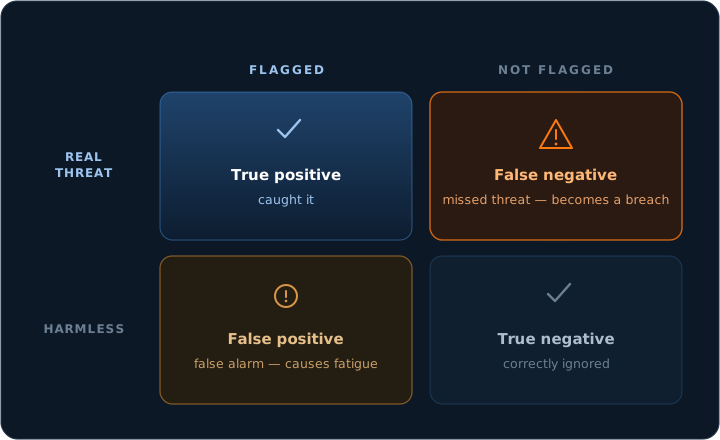
Turn detection rules up and you drown in false positives; turn them down and you risk false negatives. There’s no setting that eliminates both, which is why triage — and the judgment behind it — matters more than any single tool. The goal isn’t zero alerts; it’s a queue clean enough that the real ones stand out.
Who performs triage in a SOC?
In a security operations center, first-line (Tier 1) SOC analysts own the front of the triage queue — validating alerts, enriching them, and deciding what to dismiss or escalate. Genuine incidents are handed up to senior analysts or incident response. The structure only holds if the triage layer is consistent: the same alert should get the same decision regardless of who’s on shift, which is why a structured process and shared institutional knowledge matter as much as individual skill.
Automation and analysts: who does what
Triage at scale is impossible by hand and unsafe fully automated — it takes both.
Automation handles the volume: deduplicating, enriching with context, scoring risk, and auto-closing the obvious noise so humans never see it. Tools like SOAR (security orchestration, automation, and response) run routine triage steps automatically, and AI-assisted triage increasingly does the first pass at sorting what’s worth a look. Analysts handle the judgment: the ambiguous alerts, the “this is technically normal but feels wrong” cases, and the decision to escalate. Automation makes the queue manageable; people make it trustworthy.
Measuring triage: the metrics that matter
A handful of metrics show whether triage is actually working:
- Signal-to-noise — of the alerts that reach an analyst, how many are worth their time.
- Mean time to triage (MTTT) — how long an alert waits before someone makes a decision.
- False-positive rate — the share of alerts that turn out to be nothing.
- Alert volume handled — how much the team (and its automation) can clear without cutting corners.
The aim isn’t zero alerts — it’s a high signal-to-noise queue where a real threat can’t hide.
How to cut alert fatigue
You don’t fix alert fatigue by hiring people to read more alerts. You fix it by sending fewer, better alerts to humans:
- Tune relentlessly. Most noise comes from a handful of badly-tuned rules; fixing them removes thousands of false positives.
- Correlate, don’t just collect. One correlated story beats 20 disconnected alerts.
- Automate the obvious. If a human always closes a certain alert the same way, a machine should.
- Consolidate tools. Every extra console is another unwatched alert stream.
Doing triage in-house vs. through a managed SOC
Running triage well in-house means tooling to deduplicate and enrich, the engineering to tune it, and analysts on duty around the clock to work the queue. For most growing businesses that’s why triage comes as part of a managed SOC — the people, process, and platform that turn a flood of alerts into a short list of real ones, day and night.
How Mahoney Control approaches alert triage
A queue is only useful if you can trust how it was sorted. Mahoney Control — by Mahoney IT — deduplicates and correlates signals from across your environment on a single surface, applies automated analysis to prioritize what’s genuinely urgent, and pushes the noise out of the way. SOC analysts then investigate the ambiguous cases and escalate the real ones. Because every prioritized alert stays tied to the evidence behind it, you can see why it ranked where it did, not just that it did. That’s a triage queue you can act on, instead of one more inbox to ignore.
You can read more on our Security Operations page.
Frequently asked questions
What does it mean to triage a security alert? To review the alert, decide whether it’s a real threat or a false alarm, prioritize it by risk, and route it — dismiss, investigate, or escalate — so analysts spend their time on the alerts that matter.
What are the steps in the alert triage process? Ingestion, deduplication, enrichment, correlation, prioritization, and the final decision to dismiss, investigate, or escalate.
How does automation improve alert triage? It deduplicates, enriches, scores, and auto-closes obvious noise so analysts only see the alerts that need human judgment — raising signal-to-noise without adding headcount.
What’s the difference between alert triage and incident response? Triage decides which alerts are real and urgent; incident response is the deeper investigation and action on the ones triage escalates.
If you’d like to see what a calmer, sharper alert queue would look like for your organization, request a no-obligation security assessment.