How cyber threat detection works
Cyber threat detection turns a noisy stream of signals into the few attacks worth acting on. Here's how it works — signatures, behavior, threat intel, and response.

- Cyber threat detection is how a security team spots an attack in progress — by collecting signals across your environment and separating the few real threats from constant background noise.
- It blends two approaches: matching known-bad signatures and behavior-based detection that flags the unusual — backed by threat intelligence and frameworks like MITRE ATT&CK.
- Detection only matters if it leads to action. The hard part isn't generating alerts; it's correlating them, cutting false positives, and responding before the damage is done.
In this article
- What is cyber threat detection?
- Two ways to spot a threat
- The pipeline: from signal to action
- What threat detection looks for
- Why detection is harder than it sounds
- Where threat intelligence fits
- Detection without response is just noise
- Who runs detection: in-house or managed
- How Mahoney Control approaches threat detection
- Frequently asked questions
There’s a myth that getting breached means you had no alarms. Usually it’s the opposite: the alarms did fire — buried under thousands of others nobody had time to read. Cyber threat detection isn’t about generating more alerts. It’s about turning a flood of signals into the handful that actually mean someone is attacking you — and getting them in front of someone who can act.
This guide explains how cyber threat detection works: the two ways threats are spotted, why it’s harder than it sounds, where threat intelligence fits, and why detection without response is just expensive noise.
What is cyber threat detection?
Cyber threat detection is the practice of identifying malicious activity in your IT environment — ideally while an attack is still unfolding, not after the damage is done. It’s the “spot it” half of what the industry calls threat detection and response (TDR), and it’s what gives you visibility into an attack while it’s unfolding — not long after the damage is done.
In practice that means continuously collecting signals — from endpoints, network traffic, cloud services, and identity systems — and analyzing them for evidence of an attack. The raw material is enormous: a single mid-sized environment can produce millions of events a day. Detection is the work of finding the few that matter inside all of it. (It’s one of the core functions of a managed SOC, and it runs on the 24/7 monitoring that feeds it.)
Two ways to spot a threat
Almost all detection comes down to two complementary approaches.
Signature-based detection looks for the known bad. It matches activity against a library of indicators — file hashes of known malware, malicious IP addresses and domains, attack patterns that have been seen before. It’s fast and precise for threats anyone has documented. Its weakness is obvious: it can’t catch what it has never seen, and attackers change their tools constantly to slip past it.
Behavior-based detection looks for the unusual. Instead of asking “have we seen this exact threat before?”, it asks “is this normal for this user, this device, this network?”. A finance account logging in from two countries an hour apart, a server suddenly talking to an address it never has, a process encrypting files en masse — none of these need a known signature to be suspicious. Behavioral detection — increasingly driven by AI and machine learning that spot subtle anomalies at a scale no human could — is what catches new and evasive attacks, including insider misuse and zero-day exploitation.
| Signature-based | Behavior-based | |
|---|---|---|
| Spots | Known threats | Unusual activity |
| Strength | Fast and precise | Catches new, evasive attacks |
| Weakness | Misses the never-seen | More false positives to tune |
| Best against | Documented malware, bad IPs and domains | Insider threats, zero-days |
Neither is enough alone. Signatures give you precision on known threats; behavior gives you reach against unknown ones. Strong detection runs both and correlates the results.
The pipeline: from signal to action
Detection isn’t a single check — it’s a pipeline that turns raw telemetry into a decision.
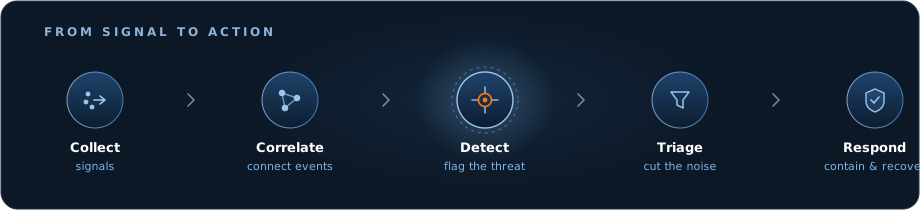
Each stage does real work:
- Collect — gather signals from across the environment into one place (typically a SIEM).
- Correlate — connect related events so a login, an endpoint alert, and a network anomaly become one story instead of three disconnected pings.
- Detect — apply signatures, behavioral analytics, and threat intelligence to flag what looks malicious.
- Triage — separate real threats from the false positives that make up the vast majority of alerts.
- Respond — investigate confirmed threats and act: contain, remediate, recover.
The single most important word there is correlate. An isolated alert is almost meaningless; the same alert next to two others tells a clear story. Detection that can’t correlate across your whole environment misses exactly the multi-step attacks that matter most.
What threat detection looks for
Detection isn’t tuned for a single attack — it watches for the traces each one leaves:
- Malware and ransomware — processes behaving like they’re encrypting or tampering with files at scale.
- Phishing and credential theft — logins that don’t fit the user’s normal pattern, like impossible travel or a first-time device.
- Insider threats — trusted accounts doing untrusted things.
- Advanced persistent threats (APTs) — slow, quiet movement that only surfaces when signals are correlated over time.
- Zero-day exploitation — attacks with no known signature, where only behavior gives them away.
Each is a reason detection leans on both signatures and behavior, not one or the other — and why correlating across the whole environment matters so much.
Why detection is harder than it sounds
If detection were just “buy a tool that flags bad things,” everyone would be safe. The hard parts are why they aren’t:
- Alert fatigue. Tools generate far more alerts than any team can review, and the overwhelming majority are false positives. Real threats get lost in the noise — the needle nobody had time to look for.
- Evasion. Attackers test their tools against common defenses before they use them, and increasingly “live off the land” with legitimate admin tools that look normal.
- Coverage gaps. A threat detected on the endpoint but invisible in the cloud, or seen at 2 a.m. when no one is watching, is a threat missed.
- Tuning. Detection rules that are too loose drown you in noise; too tight and they miss the real thing. Keeping that balance is constant, skilled work.
This is why good detection is as much about people and process as technology — someone has to tune the rules, hunt for what slips through, and judge the ambiguous cases.
Where threat intelligence fits
Threat intelligence is the context that makes detection smarter: up-to-date information on the tactics, tools, and indicators attackers are actually using right now. It feeds fresh signatures, sharpens behavioral rules, and helps analysts recognize an attack early.
Much of it is organized around MITRE ATT&CK — a public, widely used knowledge base that maps how attackers operate, step by step. Mapping detections to ATT&CK helps a security team see which attacker techniques they can catch and where the gaps are, so detection improves deliberately instead of by guesswork.
Detection without response is just noise
Here’s the part vendors skip: detecting a threat and doing nothing about it is worse than useless — it’s a false sense of security. A dashboard full of findings that no one investigates protects no one.
That’s why “detection and response” is one phrase, not two. The value isn’t in the alert; it’s in what happens next — the investigation, the decision, and the action that stops an attack before it becomes a breach. Detection is the trigger; response is the point.
Who runs detection: in-house or managed
Running detection well in-house means buying and tuning the tools (SIEM, EDR/XDR, threat intelligence) and staffing analysts around the clock — a tall order most growing businesses hand to a managed SOC or a managed detection and response (MDR) service rather than build alone.
How Mahoney Control approaches threat detection
Most tools can tell you that an alert fired. The harder question is what it means and why. Mahoney Control — by Mahoney IT — pulls signals from across your environment onto a single surface and correlates them in real time, combining automated analysis and threat intelligence to surface what actually matters — with SOC analysts who investigate and respond. Because every detection stays tied to the evidence behind it, you can see why it fired and which technique it maps to, not just that it happened — detection you can act on, rather than a black box of alerts.
You can read more on our Security Operations page.
Frequently asked questions
What’s the difference between threat detection and threat prevention? Prevention tries to stop attacks from getting in (firewalls, patching, access controls). Detection assumes some will get through anyway and focuses on spotting them quickly once they do. You need both — prevention reduces the volume, detection catches what slips past.
What are the types of threat detection? The main methods are signature-based detection (matching known-bad indicators), behavior- or anomaly-based detection (flagging the unusual), and threat-intelligence-led detection (acting on what attackers are doing now). Most security teams combine all three rather than rely on one.
Is threat detection the same as a SIEM? No. A SIEM is a tool that collects and correlates signals; it’s a foundation for detection, not the whole thing. Detection also needs behavioral analytics, threat intelligence, tuning, and analysts to act on what the SIEM surfaces.
Can threat detection be automated? Largely, yes — automation does the heavy lifting of collecting, correlating, and flagging. But deciding whether an ambiguous detection is a real attack, and how to respond, still needs human judgment.
What is MITRE ATT&CK? A free, widely used knowledge base that catalogs the techniques attackers use. Security teams map their detections to it to measure coverage and find blind spots.
If you’d like to see what stronger threat detection would look like for your organization, request a no-obligation security assessment.