SOC 2 readiness: how to prepare for your first audit
SOC 2 readiness is closing the gap between what you claim and what you can prove. A practical guide to the assessment, the five criteria, and your first audit.
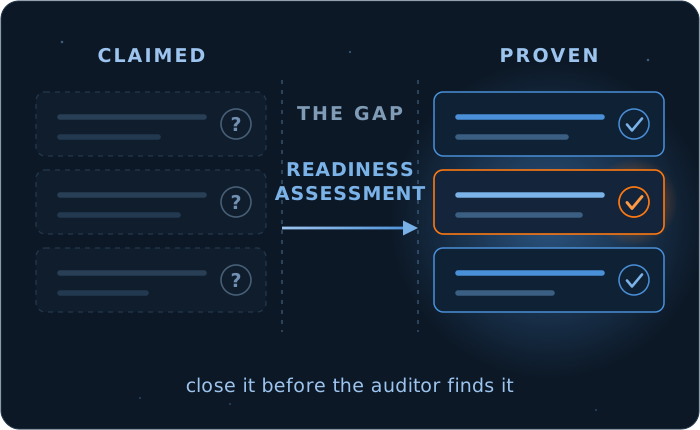
- SOC 2 readiness is not the audit — it's the work of closing the gap between the controls you claim and the evidence you can actually prove. A readiness assessment finds those gaps before an auditor does.
- SOC 2 rests on five Trust Services Criteria: Security (always required), plus Availability, Processing Integrity, Confidentiality, and Privacy (chosen by scope). Type 1 tests control design at a point in time; Type 2 tests operating effectiveness over a period of months.
- The common gaps aren't exotic — incomplete MFA coverage, no documented risk assessment, informal access reviews, and evidence scattered across spreadsheets. Continuous evidence, not a pre-audit scramble, is what makes you audit-ready.
In this article
- What is a SOC 2 readiness assessment?
- What are the five Trust Services Criteria?
- SOC 1 vs SOC 2 vs SOC 3, and Type 1 vs Type 2
- What’s in a SOC 2 compliance checklist?
- What happens during a SOC 2 audit, and how long does it take?
- Common gaps found before the examination — and how you become audit-ready
- How Mahoney Control prepares you for SOC 2
- Frequently asked questions
SOC 2 readiness is not the audit. It’s the work you do before one — closing the gap between the controls you claim to have and the evidence you can put in front of an auditor. Companies rarely fail their first SOC 2 examination because their security is weak; they fail because they can’t prove it on demand. Readiness is where you build that evidence: the difference between a pre-audit scramble and a successful audit.
This guide is for teams facing their first SOC 2 audit — usually because a customer now requires it. It covers the readiness assessment, the five criteria, Type 1 versus Type 2, a checklist, and the gaps that trip up first-timers. The through-line: you don’t become audit-ready by writing policies; you get there by proving they run.
What is a SOC 2 readiness assessment?
A SOC 2 readiness assessment is a structured gap analysis that measures your current controls against the SOC 2 requirements before the formal audit begins. Think of it as a dress rehearsal: it identifies which Trust Services Criteria you already satisfy, flags the gaps in the rest, and pins down what evidence you’ll need before an auditor arrives.
The point is to fail cheaply: a missing control found during readiness costs you a remediation task; the same gap found during the SOC 2 audit costs you a qualified report in front of the customer who asked for it. A good assessment produces a gap list, an owner for each gap, and a remediation plan. It is not the examination and produces no SOC 2 report.
What are the five Trust Services Criteria?
SOC 2 has five Trust Services Criteria: Security, Availability, Processing Integrity, Confidentiality, and Privacy. Only Security, often called the “common criteria,” is mandatory for every SOC 2 report. The other four are included based on what your service actually does and what your customers care about, which is why two SOC 2 reports are rarely identical in scope.
| Trust Services Criterion | What it covers | Typically in scope when |
|---|---|---|
| Security (required) | Protection of systems and data against unauthorized access — the baseline controls every report includes | Always — it is the common criteria for any SOC 2 |
| Availability | Systems are operational and accessible as committed in your SLAs | You promise uptime or availability commitments |
| Processing Integrity | Processing is complete, valid, accurate, and authorized | You process transactions or data on customers’ behalf |
| Confidentiality | Information designated confidential is protected throughout its lifecycle | You handle sensitive business data (contracts, IP) |
| Privacy | Personal information is collected, used, retained, and disposed of per your privacy notice | You process personal data of individuals |
These criteria describe security and processing objectives your organization may need to meet; a SOC 2 report against them is issued by an independent CPA firm, not by any software vendor. Tools can help you map and evidence your SOC 2 controls, but the examination and the report come from a licensed auditor.
Choosing which criteria apply is itself part of readiness. A focused scope — Security plus the one or two criteria your customers demand — is cheaper to prepare and easier to prove than an everything-in-scope report you can’t back with evidence. That scoping decision should follow a documented risk assessment, not a guess.
SOC 1 vs SOC 2 vs SOC 3, and Type 1 vs Type 2
SOC 1, SOC 2, and SOC 3 are three different reports for three different audiences; Type 1 and Type 2 describe how thoroughly a SOC 2 report is tested. SOC 1 covers controls relevant to a client’s financial reporting; SOC 2, operational and security controls measured against the Trust Services Criteria; SOC 3, a public-facing summary of a SOC 2, stripped of confidential detail.
The distinction most people ask about is Type 1 versus Type 2: a Type 1 report tests whether your controls are designed correctly at a single point in time, a Type 2 whether those controls actually operated effectively over a period — which is why customers almost always want a Type 2.
| SOC 2 Type 1 | SOC 2 Type 2 | |
|---|---|---|
| What it tests | Control design at a point in time | Control operating effectiveness over a period |
| The question it answers | Are the right controls in place today? | Did the controls actually work, consistently, over months? |
| Observation window | A single date | A defined period, typically several months of continuous evidence |
| What it demands of you | A snapshot of designed controls | An unbroken evidence trail across the whole window |
| What customers usually want | Accepted as a first step | The report enterprise buyers ask for |
Type 1 and Type 2 describe the scope of an independent auditor’s examination; neither is issued by a software vendor. Report timing and structure are set by the AICPA attestation standards, not by any tool.
The practical takeaway: a Type 1 can be a sensible first milestone, but the Type 2 is the report that unblocks deals — and because it grades a continuous window, the evidence discipline you build during readiness is what carries you through it.
What’s in a SOC 2 compliance checklist?
A SOC 2 compliance checklist is the working list of controls, policies and procedures, and evidence you need in place before the examination — organized around the Trust Services Criteria in your scope. It turns “we should be secure” into a set of provable, owned items.
- Access control and MFA — Multi-factor authentication enforced everywhere, least-privilege access, and evidence that every account is covered.
- Risk assessment and risk management — A documented, repeatable risk assessment that identifies threats, rates them, and drives your control decisions.
- Change management — Code and infrastructure changes reviewed, approved, and logged, with an approval trail you can produce on request.
- Monitoring and logging — Security events captured, retained, and reviewed, so you can show what happened and that someone was watching.
- Vendor management — A register of subprocessors and third parties, with evidence you assess their security — the same ground vendor questionnaires cover.
- Incident response — A written, tested incident response plan: who contains, investigates, recovers, and notifies.
- Encryption — Data encrypted at rest and in transit, with an inventory of what’s protected.
- HR controls — Onboarding, offboarding, and background checks documented, so access follows employment.
- Policies and evidence collection — The written policies and procedures that back each control, plus a repeatable way to collect the evidence that proves each control runs.
If you’re earlier in the compliance journey, our broader guide to cybersecurity compliance for small business covers the fundamentals (MFA, encryption, patching, incident response) that SOC 2 formalizes and tests.
What happens during a SOC 2 audit, and how long does it take?
During a SOC 2 audit, an independent CPA firm examines your controls, tests your evidence, and issues a SOC 2 report stating whether those controls meet the Trust Services Criteria in scope. Only a licensed CPA firm can perform the examination and issue the attestation — no software, and no consultancy, can do it for them.
The examination follows a predictable arc: the auditor confirms scope, requests evidence, samples your controls (access logs, change tickets, configuration snapshots), interviews control owners, and raises exceptions where a control is missing or didn’t operate as described, then issues an opinion in the SOC 2 report.
How long it takes depends on the report type, a property of the framework, not of any preparation service. A Type 1 assesses a single date, so fieldwork is short. A Type 2 observes your controls over a defined window — commonly three to twelve months under the AICPA standards — because the auditor needs to see them operating repeatedly, not just once. The readiness work beforehand doesn’t shorten that window; it determines whether the window is backed by clean evidence or full of gaps.
Common gaps found before the examination — and how you become audit-ready
The most common SOC 2 compliance gaps are mundane, not exotic, and each is the difference between a clean report and a qualified one.
- Partial MFA coverage. MFA on the main app but not on a legacy or cloud admin console. The fix is a coverage view that proves every account is enrolled, not a claim that “we use MFA.”
- No formal risk assessment. Controls chosen by instinct instead of a documented risk assessment. Auditors read the risk assessment as the root of your control set; without it, everything downstream looks arbitrary.
- Informal access reviews. Access that’s “reviewed sometimes.” Readiness means a scheduled, evidenced review with a record of who checked what and when.
- Untracked changes. Changes shipped without approval trails. The fix is a change process that produces the ticket, the approval, and the timestamp automatically.
- Reconstructed evidence. The biggest one: evidence assembled the week before the auditor arrives. A Type 2 grades a continuous period, and gaps in it can’t be back-filled after the fact.
Becoming audit-ready means closing those gaps and keeping the evidence continuously, not reconstructing it under pressure — the part teams underestimate. Audit readiness is a state you maintain, not a project you finish. The teams that pass their first SOC 2 audit cleanly are the ones for whom the evidence was already there when the auditor asked.
How Mahoney Control prepares you for SOC 2
Our position is straightforward: for most teams, the hardest part of SOC 2 isn’t knowing which controls to run; it’s proving, continuously, that they run — without rebuilding the evidence by hand every cycle. The stakes are rarely academic: many companies pursue SOC 2 only because a large customer made it a condition of signing — turning readiness into a deal-blocker you can’t afford to fail.
Mahoney Control, by Mahoney IT, is built to close that gap. The governance module maps your controls against the frameworks your customers hold you to — including SOC 2, ISO 27001, and NIST CSF — from a single control baseline, then correlates them with live evidence from your environment rather than a document from last quarter. The platform turns your compliance score and audit-ready output into something you can see at a glance, so a readiness review stops being a fire drill. This is mapping and evidence, not certification: certification itself is awarded by independent auditors. Mahoney Control prepares your organization for that audit. (The only formal certification Mahoney IT itself holds is ISO 9001:2015, certified by DEKRA (Germany).)
You can read more on our Governance overview.
Frequently asked questions
What is a SOC 2 readiness assessment? A SOC 2 readiness assessment is a structured gap analysis that measures your existing controls against the SOC 2 requirements before the formal examination. It produces a prioritized gap list and a remediation plan, so you fix problems on your own schedule instead of in front of the auditor. It is not the audit and produces no SOC 2 report.
Do I need a SOC 2 Type 1 before a Type 2? No — a Type 1 is optional. Some organizations use one as an early milestone to show a customer that controls are designed correctly while the Type 2 observation window runs; others go straight to Type 2, since that’s the report most enterprise buyers ask for.
Who can issue a SOC 2 report? Only an independent, licensed CPA firm can perform a SOC 2 examination and issue the report. Vendors, consultancies, and readiness tools can help you map controls, close gaps, and assemble audit-ready evidence — but the examination and opinion must come from a qualified auditor. Anyone claiming to hand you a “SOC 2 certificate” directly is misrepresenting how the attestation works: there is no certificate, only the auditor’s report.
Is SOC 2 a certification? Not exactly. SOC 2 is an attestation, not a certification: an independent CPA firm examines your controls and issues a report with an opinion, rather than a pass/fail certificate. That’s why an honest tool describes its role as mapping controls and producing evidence to prepare you for the audit; the report itself always comes from the auditor.
If you’d like to see what continuous, evidence-based SOC 2 readiness would look like for your organization, request a no-obligation consultation.