Cybersecurity audit preparation: how to be ready before the auditor arrives
Most organizations don't fail a cybersecurity audit on security — they fail on evidence. What auditors ask for, how to prepare, and what follows the report.

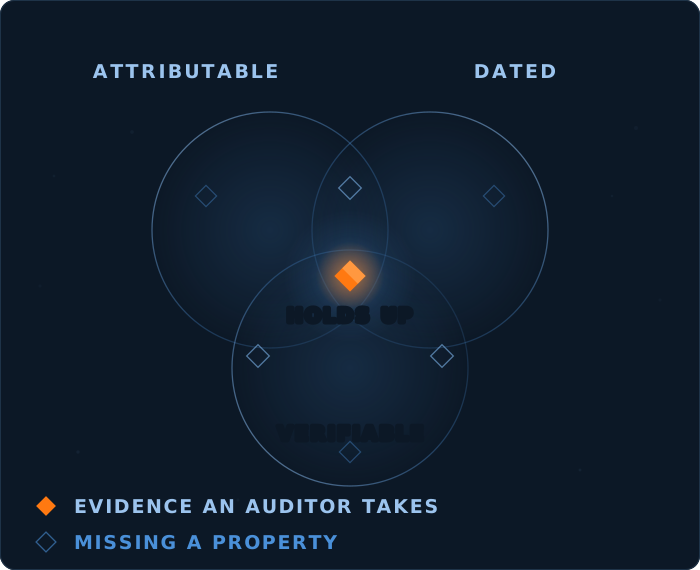
- Audit evidence must be attributable, dated, and verifiable — all three at the same time. A screenshot fails the dating test; a policy document fails verifiability.
- What separates evidence that holds up from evidence that doesn't isn't effort. It's whether the record is a byproduct of operating or a project you run twice a year.
- The audit doesn't end with the report. Findings, remediation, and retesting decide the next audit, and a repeat finding reads far worse than a new one.
In this article
- What is a cybersecurity audit?
- The types of security audit you’ll actually face
- Why organizations fail cybersecurity audits
- The three properties every piece of evidence needs
- How to prepare for a cybersecurity audit: the checklist that matters
- Where audit evidence actually comes from
- Inside the fieldwork
- What happens after the report
- How Mahoney Control makes audit evidence a byproduct
- Frequently asked questions
If preparing for a cybersecurity audit means two weeks of dropped work, spreadsheet archaeology, and screenshots pulled from five systems under pressure, the audit already found something — before it started.
Auditors rarely discover that a company has no security. They discover that a company can’t show what its security did on the days that mattered. The control ran; nobody can prove it. That gap between doing and showing is where most findings come from, and it’s the gap this guide is about.
What is a cybersecurity audit?
A cybersecurity audit is a formal, independent examination of your security controls against a defined standard, ending in a written opinion or report. The examiner samples evidence — configurations, logs, security policies, tickets, access reviews — and tests whether what you claim matches what your environment actually does, across a defined period rather than on the day of the visit.
You’ll see it called an information security audit or a cyber security audit depending on who’s asking, and a compliance audit when the standard comes from a regulator or a contract rather than a certification body. Whatever the label, an independent party tests your stated security measures against the record your environment produced.
Three terms get used interchangeably, and the differences decide how you prepare:
| What it answers | Who performs it | What you get | |
|---|---|---|---|
| Cybersecurity audit | Do your controls meet a defined standard, provably, over time? | An independent auditor or assessor | A report or opinion, plus findings |
| Security assessment | How strong is your overall security posture, and where should you invest? | Internal team or a consultancy | Recommendations, no formal opinion |
| Penetration test | Can an attacker actually get in? | Offensive security specialists | Exploited paths and technical findings |
A clean pen test proves nothing about your audit outcome, though its results often become one exhibit inside the audit.
The types of security audit you’ll actually face
Preparation depends less on the framework than on who’s asking and why. Four situations cover almost everything:
- Internal audit. Your own team tests controls before anyone external does. No formal opinion, no external consequence: internal audits earn their keep by surfacing findings while they’re still cheap to fix.
- External audit against a framework. A licensed CPA firm examines controls for SOC 2 — the preparation beforehand is SOC 2 readiness, which is not the examination itself; an accredited certification body does the equivalent for ISO 27001, the information security management standard. Both produce the report your customers ask for. A voluntary framework such as the NIST Cybersecurity Framework (CSF) can be assessed against but has no certification scheme of its own.
- Customer-driven audit. A large client exercises an audit clause, or sends one of its own security assessments in place of one. It often arrives first as paperwork: the vendor security questionnaire is the same demand in a lighter form.
- Regulatory or insurer review. A supervisory authority reviews specific data protection obligations; a cyber insurance underwriter weighs the cyber risks the insurer is being asked to carry. This kind of compliance audit is narrow in scope. The consequences of a gap are not.
These frameworks describe security objectives an organization may need to meet; certification or attestation against them is awarded by independent auditors, not by any software vendor. Tools can help map and evidence controls, but the audit and the report come from an accredited third party.
Why organizations fail cybersecurity audits
Audit findings cluster, and they cluster in the same few places nearly every time. Almost none of them are “you have no security.”
- The evidence doesn’t exist for the period under review. Access reviews happened, but informally and undated. Patches went out, but which machines and when lives in someone’s memory. The auditor samples March; you can show today.
- The policy and the practice have drifted apart. Your written security policies and procedures say quarterly; the reality is twice a year and everyone’s fine with that. Auditors test against your document, so an aspirational policy becomes a finding you wrote yourself.
- Scope was defined too late or too loosely. Systems appear in the examination that nobody meant to include — a legacy console, a second location, a subsidiary’s tenant. Scope creep during fieldwork is expensive and avoidable.
- No named owner per control. When the auditor asks who approves privileged access, the answer is a meeting rather than a person. Unowned controls produce inconsistent evidence.
- Third parties were never assessed. Vendor management is an explicit control area in the major frameworks, and it’s routinely the thinnest folder in the binder — which is why the vendor security questionnaire you send is itself audit evidence.
- Findings from the last audit were never closed. A repeat finding reads far worse than a new one, because it says the management response wasn’t real.
Notice what’s absent from that list: firewalls, encryption algorithms, endpoint tooling. The security measures themselves are usually fine. The record of them isn’t. Most security gaps an audit surfaces were never gaps in protection; they were gaps in proof, open for months without anyone knowing.
The three properties every piece of evidence needs
Three of those six are the same failure wearing different clothes. Audit evidence has to satisfy three properties at once, and when it fails, it fails one of them:
- Attributable — it names this system, this account, this configuration. The unowned control fails here: nobody can say whose record it is.
- Dated — it covers the period under review, not today. Sampling March and showing today is a dating failure, and it’s the one nobody plans for.
- Verifiable — it reflects the live environment, not someone’s recollection. The policy that says quarterly while practice says twice a year fails here.
The other three are different in kind: loose scope and unassessed third parties are about what got examined rather than whether the proof held, and an unclosed finding from last time is a remediation failure, which is its own chapter below. But where evidence itself fails, it fails on one of these three words. They decide whether an auditor takes the artifact or writes it up.
How to prepare for a cybersecurity audit: the checklist that matters
Here’s the awkward thing about the usual audit checklist: the middle of it isn’t audit work at all. Ownership, self-assessment, and remediation are how you run a security program. If they only happen because an examination is scheduled, that pressure is the real finding, whether or not the report ever names it. Only the first and last items — the scope and the session — genuinely belong to the audit. If you don’t yet have a control baseline to be audited against, that’s the earlier problem, and our guide to cybersecurity compliance for small business covers it.
1. Fix the audit scope in writing, early. Which entities, locations, systems, and sensitive data are in the examination, and just as explicitly which aren’t. Settle the audit objectives at the same time, because scope without a stated objective drifts. Every ambiguity here becomes an argument during fieldwork, when it costs the most.
2. Assign an owner to every control. A named person, not a team — someone who knows what the control does, where its evidence lives, and can answer the auditor without escalating. This one step removes much of the fieldwork friction teams tend to blame on the auditor.
3. Run a self-assessment before the real one. Pick a date in the period, ask for the evidence, and see whether it appears without a hunt. What you’re testing isn’t the control; it’s your ability to produce proof on demand. Run it against the three properties: for each control, is the evidence attributable, dated, and verifiable?
4. Remediate, and document the remediation. Fix what the self-assessment surfaced, then keep the record of the fix, dated. A gap you closed and can prove you closed is a non-event. The same gap, closed silently, still looks open.
5. Prepare the people, not just the file. Whoever meets the auditor should know the scope, know their controls, and answer the question asked. Speculation, over-explaining, and volunteering scope are the three ways a routine session grows a finding.
Where audit evidence actually comes from
This is the step most guides skip. They list what gets examined; they rarely say how the proof gets produced.
Start with the artifact almost everyone reaches for first. A screenshot is attributable and verifiable at the instant it was taken, but it is never dated in the sense an auditor means: it proves a setting was correct when someone took it, which is almost never the moment being sampled. Spreadsheets and text documents fail differently. They stay dated and attributable while quietly losing verifiability, because nothing connects them to the live environment anymore, and nothing tells you when that connection broke.
Which property tends to break also depends on the control domain, and knowing that in advance is most of the preparation:
| Control domain | What the auditor typically asks for | The property that usually fails |
|---|---|---|
| Access control | Joiner-mover-leaver records for the sampled month, not a current account list | Dated — the review happened, informally and without a date |
| Data protection | The encryption inventory as it stood at period start, plus the change record for anything added since | Verifiable — the standard is documented; coverage was never checked against reality |
| Network security | Configuration state on the sampled dates, and the change tickets that authorized each move | Dated — current state is easy; the state in March is not |
| Endpoint and vulnerability management | Patch and scan status on the sampled dates, and proof that each finding was closed | Dated — the scan is kept; the closure record isn’t |
| Incident response | The plan, plus a real or tested security incident from within the period: detection, decisions, timeline, outcome | Verifiable — the plan exists; evidence it was ever exercised doesn’t |
| Resilience | A restore actually performed during the period, not a backup job that reported success | Verifiable — backups self-report; restores go untested |
| Security awareness | Completion per named person for each cycle in the period | Attributable — an aggregate completion rate, with no way to show who |
| Third parties | Who assessed which vendor, on what date, against what | Attributable — a vendor list with no record of the assessment behind it |
Read the right-hand column and the useful pattern isn’t which property fails most. It’s that none of these is a failure of protection. Dated and verifiable account for six of the eight domains between them, and in practice both mean the same thing: the control ran, and nothing was writing it down at the time.
Evidence generated continuously from the systems themselves is far less exposed to that. Patch status, endpoint health, and configuration state pulled from the platforms already running in your environment are attributable, dated, and verifiable by design. The difference isn’t effort — it’s whether the record is a byproduct of operating or a project you run twice a year. Which is also why data security and audit evidence aren’t separate workstreams, though most organizations staff them as if they were: the same telemetry that tells you a control is working tells an auditor that it worked.
Inside the fieldwork
Fieldwork is more procedural than most teams expect. The audit process runs in batches: the examiner requests evidence, samples specific dates, interviews control owners, and logs what they find. Some of what they ask for won’t have been on the list they sent in advance. That’s normal, not a trap.
The distinction worth understanding is between an exception and a finding. An exception is a single instance that didn’t go according to plan: one termination processed late, one review missed in a quarter. A finding is a judgment that the control itself isn’t operating reliably. Exceptions turn into findings when the examiner can’t tell which of the two they’re looking at; a documented one-off with a cause reads as an exception, an unexplained gap reads as a pattern.
That is also why two answers that sound almost identical carry very different consequences. “We don’t do this” costs you one control. “We do this, we just can’t find the record” costs you the same control and raises a question about every other record you’ve handed over. The first is a gap; the second is a credibility problem, and it spreads.
Findings drafted at the end of fieldwork are usually discussed with you before the report is issued. That conversation exists to supply the artifact that was missing when the question was first asked — not to argue the conclusion.
What happens after the report
The report is the middle of the process, not the end. This is the part almost nobody prepares for.
Findings arrive rated by severity, each requiring a management response: what you’ll do, who owns it, and by when. That response is a commitment, and the next audit opens by testing it. Which is why the single most damaging outcome isn’t a finding — it’s a repeat finding, because it tells the reader the response was paperwork. Audit reports circulate further than most teams assume: to customers, insurers, and boards, each reading them as a statement about how you manage security risk.
So the closing loop is worth running deliberately: accept or dispute each finding on the facts, assign an owner and a date, fix the underlying cause rather than the sampled instance, keep the evidence of the fix, and re-test it yourself before anyone else does. Then treat the corrected control as something that produces its own record from now on.
By design, regular audits catch drift late: they’re a sampling exercise, not continuous monitoring. Between them, your documented posture and your actual one separate quietly, with no one watching. The distance only closes when security practices leave their own record while they run.
How Mahoney Control makes audit evidence a byproduct
The scramble before an audit isn’t a scheduling problem; it’s an evidence problem. Teams don’t lose that time because the controls are missing. They lose it because the proof has to be reassembled by hand, from systems that were never asked to keep a record.
Mahoney Control, by Mahoney IT, is built to close that gap by generating evidence from the environment as it operates. Its governance module correlates your documented posture with live data from your RMM, EDR, and cloud platforms: patch status, endpoint health, and configurations pulled through APIs, so the record stays current and verifiable rather than a screenshot from last quarter.
The same module maps those controls against the frameworks your auditors ask about — including SOC 2, ISO 27001, and NIST CSF — from a single control baseline, and a compliance score heatmap shows where the gaps sit by control domain. Its audit-ready output packages that evidence for export — the heatmap as a PDF, controls and evidence as records mapped to the standards in scope — so the examination becomes a matter of pulling records rather than rebuilding them. This is mapping and evidence, not certification: certification itself is awarded by independent auditors. Mahoney Control prepares your organization for that audit. (The only formal certification Mahoney IT itself holds is ISO 9001:2015, certified by DEKRA (Germany).)
You can read more on our Governance overview.
Frequently asked questions
What is the difference between a cybersecurity audit and a penetration test? A penetration test is adversarial and technical: it asks whether someone can get in, and its output is exploited paths. An audit is evidentiary: it asks whether the controls you documented operated across a period, and its output is an opinion with findings. A pen test can be commissioned and completed in isolation; an audit depends on records you either kept or didn’t.
What is the most common security audit finding? Missing or incomplete evidence for the period under review — a dated failure, in the terms above. The control usually exists; the record that it operated on the sampled dates doesn’t. The second most common is a policy describing a cadence the organization doesn’t actually keep.
How long does audit preparation take? That depends on the standard and on your own starting point. The examination window is a property of the framework: a point-in-time examination looks at one date, while a period-of-time examination requires the controls to have operated across months, which can’t be compressed after the fact. On your side, the drivers are scope breadth, the number of entities and locations, how many controls have a named owner, and how much evidence already exists in retrievable form. The last one usually decides whether the timeline is comfortable or a scramble.
What does a cybersecurity audit cost? The auditor’s fee is quoted against scope: controls, entities, locations, and the length of the period examined. The bigger cost is usually internal — the engineering and management hours spent reconstructing evidence during fieldwork, every cycle. That’s also the part of the bill you have most influence over.
Do we need a security certification to pass a customer’s audit? Not necessarily. Many customer reviews are satisfied by policies, a penetration test summary, and demonstrable controls with evidence behind them. A report against a recognized standard is issued by an independent auditor and removes the need to prove the same points to every customer separately — it isn’t a prerequisite for passing a customer’s review.
What happens if we fail a security audit? Most examinations don’t end in a binary pass or fail; they end in findings with severities and a required management response. What matters is closing them at the root and evidencing the fix, because unresolved findings reappear in the next report — and a repeat finding is read far more harshly than a first one.
If you’d like to see what continuously generated audit evidence would look like for your organization, request a no-obligation consultation.
This article is general information on audit practice and does not constitute legal or audit advice.