Cybersecurity compliance for small business: a practical guide
Cybersecurity compliance for small business is provable operational discipline. A practical guide to frameworks, best practices, and staying audit-ready.

- Cybersecurity compliance for small business isn't a checkbox you tick once a year — it's provable operational discipline: security measures that actually run, backed by evidence you can show on demand.
- Compliance and general IT security overlap but aren't the same. Security keeps attackers out; compliance proves — to auditors, insurers, and customers — that your safeguards are real and working.
- You don't need an enterprise budget to get there. A handful of best practices (MFA, encryption, patching, an incident response plan, and a culture of security) covers most of what frameworks like NIST and the SBA recommend.
In this article
- What is cybersecurity compliance?
- Why cybersecurity compliance matters for small businesses
- How does compliance differ from general IT security?
- Common frameworks and standards small businesses encounter
- Cybersecurity compliance best practices for small businesses
- What compliance does beyond avoiding fines
- How often should a small business review its controls?
- How Mahoney Control approaches compliance for smaller teams
- Frequently asked questions
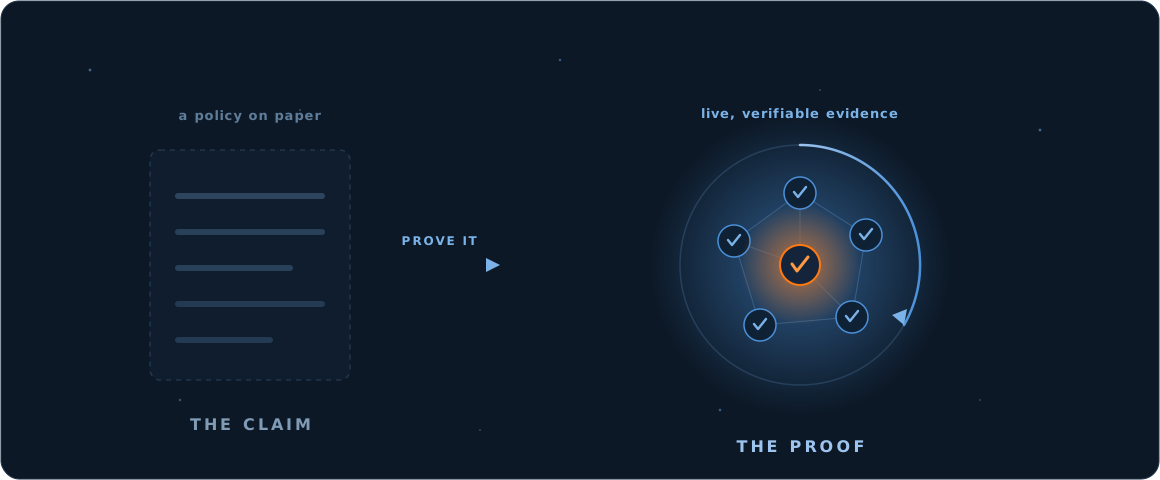
Compliance is not a checkbox. It’s provable operational discipline — the difference between claiming your business is secure and being able to show it when a customer, an insurer, or a regulator asks. For small businesses, that distinction has stopped being optional. The cybersecurity threats that used to target only large enterprises now hit companies of every size, and the people you do business with increasingly want proof that you can defend their sensitive data before they’ll sign.
That’s the shift this guide is about. Cybersecurity compliance for small business used to mean a binder of security policies no one read. Today it means a living set of security measures you can demonstrate at any moment. Prove it, don’t claim it — that’s the whole game.
What is cybersecurity compliance?
Cybersecurity compliance is the practice of meeting a defined set of security requirements — from a law, an industry standard, or a customer contract — and being able to demonstrate that you meet them. The demonstration part is what people miss. A control that exists only on paper isn’t compliance; it’s a liability waiting for an audit.
Those requirements come from cybersecurity regulations and standards. Some are legal mandates: the Federal Trade Commission (FTC) Safeguards Rule, HIPAA (the Health Insurance Portability and Accountability Act) for health data, and PCI DSS for card payments. Others are voluntary frameworks that customers or insurers ask you to follow, such as the NIST Cybersecurity Framework, SOC 2, and ISO 27001. Either way, regulatory compliance boils down to a simple loop: define the security measures that protect your sensitive information, put them into practice, and keep evidence that they’re actually running.
For a small business, that evidence is the hard part — not because the controls are complex, but because proving they work every day, across every device, is tedious when it’s done by hand in spreadsheets.
Why cybersecurity compliance matters for small businesses
Cybersecurity compliance matters for small businesses because they are now a primary target for cyberattacks, not an unlikely one — and because proof of security has become a condition of doing business. The old assumption (“we’re too small to be a target”) is exactly what makes small businesses attractive. Attackers know smaller companies tend to have weaker security measures and thinner IT coverage, so automated ransomware and phishing campaigns run by cybercriminals sweep them up by the thousand. According to repeated industry reporting and guidance from bodies like the U.S. Small Business Administration (SBA) and the Cybersecurity and Infrastructure Security Agency (CISA), a large share of cyberattacks are aimed at small businesses precisely because the return on effort is high and the defenses are often low.
Compliance matters because it forces the discipline that closes that gap. But there’s a second, more immediate driver: it’s increasingly a condition of doing business. Cyber-insurance providers now send detailed questionnaires before they’ll issue or renew a policy — asking whether you enforce multi-factor authentication, encrypt sensitive data, and maintain an incident response plan. Answer wrong, and your premium climbs or coverage disappears. And the cost of a single data breach, counting recovery, downtime, legal exposure, and lost trust, routinely dwarfs the cost of the controls that would have prevented it. Compliance isn’t the expense here. The breach is.
How does compliance differ from general IT security?
Compliance and general IT security are related but answer different questions: security asks whether you are protected, while compliance asks whether you can prove it to a standard someone else has set. People use the two words as if they mean the same thing. They don’t.
You can be reasonably secure and still fail an audit — because failing to document, monitor, and evidence your controls is itself a compliance gap. And you can technically satisfy a checklist while leaving real cybersecurity risk unaddressed, which is how “compliant” companies still get breached. The two only work when they reinforce each other.
| General IT security | Cybersecurity compliance | |
|---|---|---|
| Core question | Are we protected against cyber threats? | Can we prove our safeguards meet a defined standard? |
| Driven by | Actual risk to your systems and data | Regulations, standards, contracts, insurers |
| Success looks like | Attacks blocked, breaches prevented | Documented, evidenced, audit-ready controls |
| Typical artifacts | Firewall, antivirus, MFA, encryption | Security policies, evidence logs, framework mappings |
| Fails when | A vulnerability is exploited | A control can’t be demonstrated on demand |
The takeaway: security is the work, compliance is the proof that the work is happening. A firewall that blocks an intrusion is security. The log showing it was configured, monitored, and reviewed is compliance.
Common frameworks and standards small businesses encounter
Small businesses rarely get to pick their framework — your industry, your customers, and your data pick it for you. The table below covers the cybersecurity standards and compliance requirements small businesses run into most, and what each is actually for. PCI compliance follows anyone who touches card payments; HIPAA follows anyone who touches health data.
| Framework / standard | What it covers | Who typically needs it |
|---|---|---|
| NIST Cybersecurity Framework (CSF) | A flexible, voluntary structure for identifying, protecting against, detecting, responding to, and recovering from cyber threats | Any business wanting a credible baseline; often referenced by contracts |
| FTC Safeguards Rule | Legally required security measures to protect customer information | Financial-adjacent businesses (lenders, advisors, dealers) in the US |
| SOC 2 | Independent report on how a company safeguards customer data | SaaS and service providers whose clients demand assurance |
| PCI DSS | Protection of payment card data | Anyone who stores, processes, or transmits card payments |
| HIPAA | Safeguards for protected health information | Healthcare providers and their vendors |
| ISO 27001 | International standard for an information security management system | Businesses needing globally recognized certification |
These frameworks describe security objectives your organization may need to meet; certification against them is awarded by independent auditors, not by any software vendor. Tools can help you map and evidence your controls, but the audit and the certificate come from an accredited third party.
The good news for a small business: these frameworks overlap heavily. Strong passwords, MFA, encryption, patching, and an incident response plan show up in nearly all of them. Get the fundamentals right once, and you’ve covered most of what any single standard asks for.
Cybersecurity compliance best practices for small businesses
You don’t need an enterprise security team to build a defensible cybersecurity posture. You need a short list of best practices, applied consistently and evidenced. These are the cybersecurity measures, the baseline cyber hygiene, that frameworks like the NIST CSF and SBA guidance return to again and again.
- Enforce multi-factor authentication (MFA). The single highest-leverage control you can deploy, stopping the vast majority of account-takeover and phishing attacks that rely on stolen passwords alone — backed by a coverage report that proves every account is actually enrolled.
- Require strong passwords and a password manager. Long, unique credentials per account, never reused, with the manager’s audit view showing which accounts still fall short.
- Encrypt sensitive data at rest and in transit. Encryption turns a lost laptop or intercepted file from a breach into a non-event, and an up-to-date inventory shows exactly what’s protected and what isn’t.
- Keep a firewall and antivirus running and current. Perimeter and endpoint protection stay baseline hygiene; the point is a status view proving they’re active, updated, and monitored, not just installed.
- Patch known vulnerabilities on a defined cycle. Most successful cyberattacks exploit a flaw a patch already existed for, so a defined update cycle plus a patch log auditors and insurers can see is compliance and security in one move.
- Write and rehearse an incident response plan. Know who does what when something surfaces: contain, investigate, recover, notify — and keep the tested plan and drill records auditors and insurers ask for.
- Train your people and build a culture of security. The strongest control is a workforce that recognizes a phishing email and reports it, with training-completion records that prove the culture is real, not assumed.
None of these are exotic. What separates a compliant small business from a vulnerable one isn’t owning better tools — it’s running these consistently and keeping the evidence that you do. Small and medium-sized businesses that lack in-house staff often turn to managed security services to run and evidence these controls for them.
What compliance does beyond avoiding fines
Framing compliance purely as fine-avoidance sells it short. Fines are real, but they’re the floor, not the reason.
Done properly, compliance is a growth enabler. It shortens sales cycles, because you can answer a customer’s security questionnaire with evidence instead of promises. It lowers your cyber-insurance friction, because you can demonstrate the controls underwriters require. It builds genuine resilience, because the discipline of continuous evidence means you actually catch drift, whether a disabled control or an unpatched machine, before it becomes an incident. And it earns trust: in a market where every vendor claims to be secure, being able to show it is a differentiator.
That’s the reframe worth internalizing. Compliance isn’t a tax on doing business. It’s the operational discipline that makes a small business credible to larger customers, insurable on good terms, and harder to breach — all at once.
How often should a small business review its controls?
A small business should monitor its core controls continuously and run formal checkpoints on a set cadence. A point-in-time annual audit is not enough on its own. The instinct to treat compliance as a once-a-year event — scramble before the audit, then forget it until next year — is exactly what produces “compliance drift,” where your documented cybersecurity posture and your actual posture quietly diverge over months.
A workable rhythm for most small businesses: monitor the fundamentals continuously (patch status, MFA coverage, endpoint health), run a lightweight internal review each quarter, and do a full controls-and-evidence review annually or whenever something material changes — a new system, a new regulation, a new major customer. This cadence is the backbone of a durable cybersecurity strategy. The goal isn’t more paperwork. It’s making sure that at any given moment, what you claim is what’s actually true.
How Mahoney Control approaches compliance for smaller teams
Our position is straightforward: for a small business, the hardest part of compliance isn’t deciding what controls to run — it’s proving, continuously, that they’re running, without burning weeks in spreadsheets.
Mahoney Control — by Mahoney IT — is built to close that gap. The governance module maps your security controls against the frameworks your customers hold you to — including SOC 2, ISO 27001, and NIST CSF — from a single control baseline, and correlates them with live evidence from your actual devices rather than a document from last quarter. The platform turns a compliance score and audit-ready output into something you can see at a glance, so a review stops being a fire drill. This is mapping and evidence, not certification: certification itself is awarded by independent auditors. Mahoney Control prepares your organization for that audit. (The only formal certification Mahoney IT itself holds is ISO 9001:2015, certified by DEKRA (Germany).)
You can read more on our Governance overview.
Frequently asked questions
What is cybersecurity compliance for a small business? Cybersecurity compliance for a small business means meeting a defined set of security requirements, whether from a law, a standard like NIST, or a customer contract, and being able to prove you meet them. The proof matters as much as the controls: a safeguard you can’t demonstrate isn’t compliance. In practice it is a continuous loop of running security measures and keeping evidence that they work.
Are small businesses really targeted by cyberattacks? Yes. Attackers favor smaller companies precisely because their security measures are often lighter and their IT coverage thinner. Automated ransomware and phishing campaigns don’t check your size first, and guidance from bodies like the SBA and CISA consistently flags small businesses as a major target for cybercriminals.
How is compliance different from general IT security? Security is protecting your systems against cyber threats; compliance is proving those safeguards meet an external standard. You can be secure and still fail an audit if you can’t evidence your controls, and you can pass a checklist while leaving real cybersecurity risk unaddressed. The two work best when they reinforce each other.
What are the most important compliance best practices to start with? Start with multi-factor authentication, strong unique passwords, encryption of sensitive data, an active firewall and antivirus, prompt patching of every known vulnerability, and a written incident response plan — reinforced by ongoing training to build a culture of security. These fundamentals of cyber hygiene cover most of what any single framework requires, which makes them the highest-return place to begin.
How often should we review our cybersecurity controls? Monitor the fundamentals continuously, run a lightweight internal check each quarter, and do a full controls-and-evidence review annually or whenever something material changes. Point-in-time reviews let your real cybersecurity posture drift away from your documented one between audits, so continuous monitoring is what keeps compliance honest.
If you’d like to see what continuous, evidence-based compliance would look like for your business, request a no-obligation consultation.