
HIPAA Security Rule evidence,
while care keeps running.
For hospitals, clinics, practices, and labs with small IT teams: your safeguards checked against live data from the tools you already run, and a plain line where the platform stops.
Request a demoEight requirements of the HIPAA Security Rule, 45 CFR Part 164, Subpart C — named here, not claimed as met.
60days
The outer limit for notifying individuals of a breach of unsecured protected health information: without unreasonable delay, and no later than 60 calendar days after discovery (45 CFR 164.404(b)).
500
Individuals affected — from this number on, HHS is notified at the same time as the individuals (45 CFR 164.408(b)).
6years
How long Security Rule documentation is kept, counted from its creation or the date it was last in effect, whichever is later (45 CFR 164.316(b)(2)(i)).
Turn on HIPAA
The requirements, checked against your own data
-
From the official text
Select HIPAA, and the platform imports the requirements of 45 CFR Part 164 as draft controls for you to review before they count.
-
Fed by the stack you run
Device inventory, security events, and patch status come in from supported RMM and endpoint detection tools and from Microsoft 365.
-
Every status has a source
Each result stores what was observed, so anyone can see why a control reads the way it does.
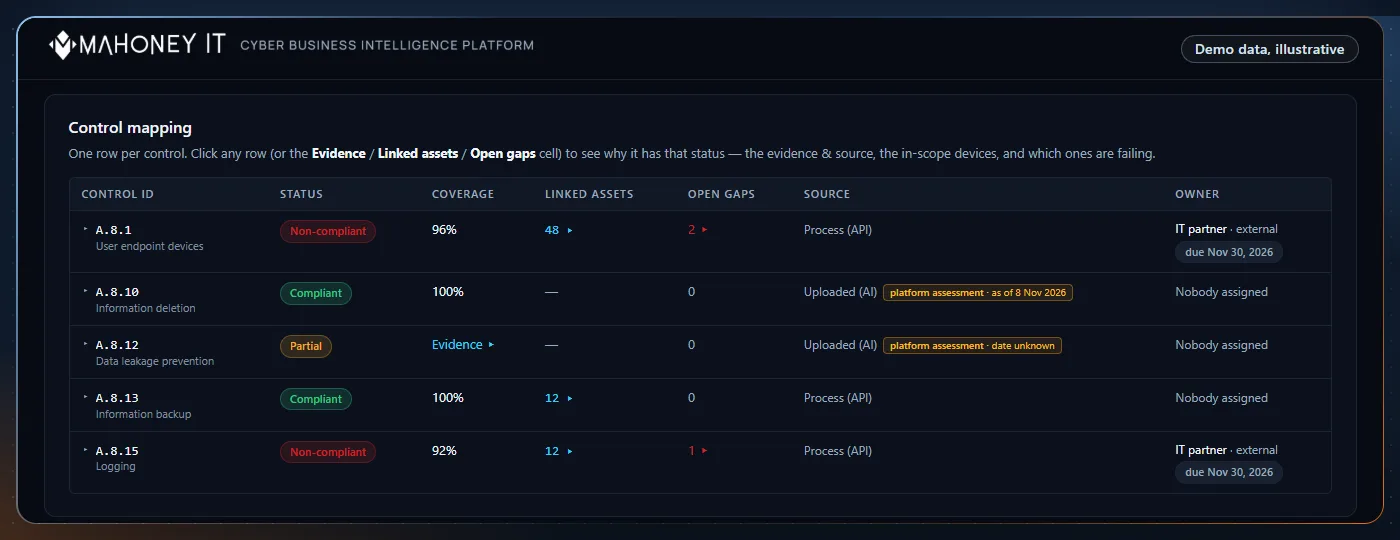
Mahoney Control maps customer controls against frameworks such as HIPAA. This does not constitute certification of Mahoney IT against these standards. Where certification exists, it is awarded by independent auditors. The screenshot shows the ISO 27001 view with demo data; status labels (Compliant, Partial, Non-compliant) are the platform’s assessment per control, not an audit result.
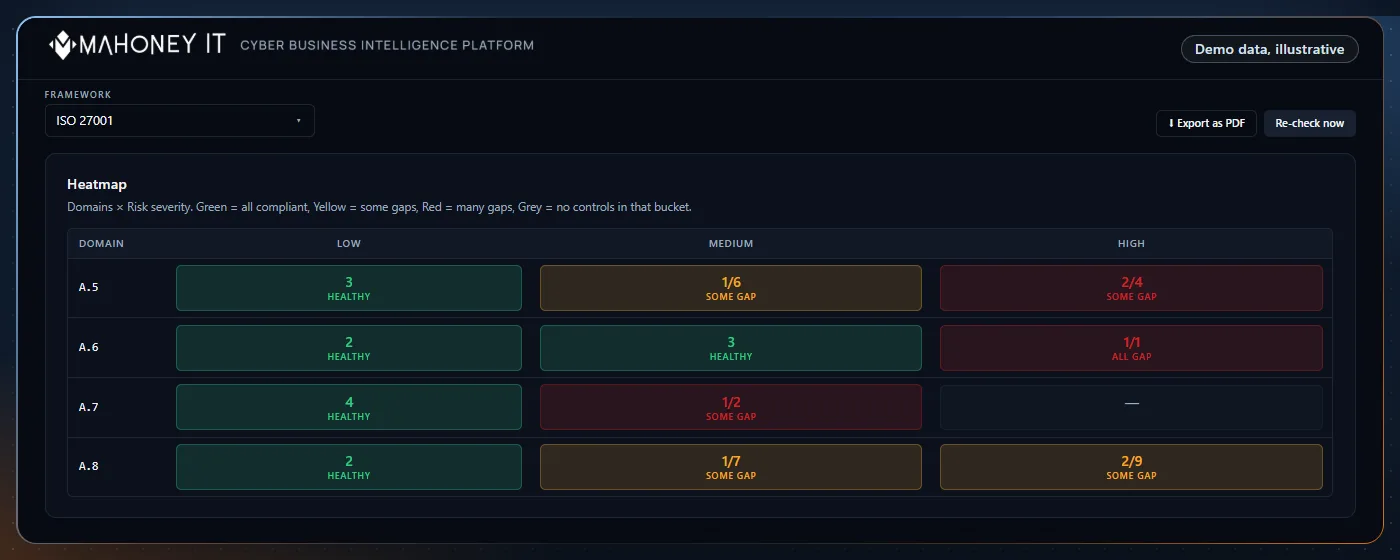
Mahoney Control maps customer controls against frameworks such as HIPAA. This does not constitute certification of Mahoney IT against these standards. Where certification exists, it is awarded by independent auditors. The screenshot shows the ISO 27001 view with demo data; status labels (Compliant, Partial, Non-compliant) are the platform’s assessment per control, not an audit result.
What you end up holding
Gaps in writing, evidence on file
-
A draft plan for each gap
On request, AI drafts what to fix and how, as advice to review with your team. Available from the Essential plan; AI usage is billed as shown on the pricing page.
-
An evidence register
Passing evidence, exportable as CSV or as a printable report. It is not a certification or an audit result.
-
Access for your auditor
Read access for a dated audit window. It ends on its own, and every page the auditor opens is on record.
What Mahoney Control measures and keeps on file. Measuring a safeguard is not the same as meeting it; whether an organization meets the HIPAA Rules is for its counsel and for HHS to say.

The transition
One duty starts a clock.
Most safeguards are ongoing work. Breach notification is different: it counts from the day a breach is discovered.
Sixty days, counted from discovery
- The clock starts here
A breach is discovered
From this day on, the count runs toward notifying the individuals whose information was involved.
-
Notice to individuals
Without unreasonable delay, and no later than 60 calendar days after discovery.
-
500 or more individuals
HHS is notified at the same time as the individuals.
-
Fewer than 500
Logged, and reported to HHS no later than 60 days after the end of the calendar year in which they were discovered.
Once you state in the alarm plan that HIPAA applies to you, Mahoney Control tracks the notice to individuals and, from 500 individuals, the notice to HHS. Breaches below 500 are not counted there. The tracker is an orientation aid, not legal advice, and the deadlines are the regulation’s, not a service commitment of ours.
See the breach clock in a demo
A platform can hold the evidence.
It cannot decide whether HIPAA reaches you.
Where we start, and where we stop
Mahoney IT
What you can evidence.
HIPAA is one of the frameworks built into the platform. Selecting it does not make anyone compliant — the product says so on the screen where you select it. Policies, training, and other organizational safeguards are attested by people, not measured by software.
See it against your own controlsYour counsel and HHS
Who the Rules cover in the first place.
The HIPAA Rules apply to covered entities and their business associates. Whether an organization is one of them is a question for its counsel and for HHS. It is a legal determination, and we do not make it for you.
Read the HHS guidance on covered entitiesMahoney Control maps customer controls against frameworks such as HIPAA. That mapping is not a certification of Mahoney IT or of any customer, and there is no HIPAA certification. Where certification exists, it is awarded by independent auditors against their own criteria. Mahoney IT Group Germany holds ISO 9001:2015, certified by DEKRA — a quality management certification, which says nothing about the requirements described on this page.
Before you book the demo
Does Mahoney Control make a healthcare organization compliant with HIPAA?
No, and no software does. There is no HIPAA certification; whether an organization meets the Rules is a question for its counsel and, in enforcement, for regulators such as the HHS Office for Civil Rights. Mahoney Control keeps the controls, signals, and documents a review asks to see, each with its source. Organizational safeguards, such as policies and workforce training, are attested by people, not measured by the platform.
Is HIPAA built into the platform?
Yes. HIPAA is one of the frameworks a customer can select in Mahoney Control. The official requirements of 45 CFR Part 164 are imported as draft controls, which the customer reviews before relying on them. Mapping controls against a framework is not a certification of Mahoney IT or of any customer.
Does the platform replace the HIPAA risk analysis?
No. 45 CFR 164.308(a)(1)(ii)(A) asks for an accurate and thorough assessment of the potential risks and vulnerabilities to the confidentiality, integrity, and availability of electronic protected health information, and that assessment is work done by people. Mahoney Control supplies measured input for it: device inventory and attributes, security events, patch status, and which tools are connected. Rules the platform cannot measure stay marked as needing human attestation.
Does a healthcare organization have to replace its existing tools?
Usually not. Mahoney Control reads supported tools already in place: Datto RMM, Microsoft Defender or Sophos Central for endpoint detection, and Microsoft 365, and turns their signals into evidence. Where a control is missing entirely, it shows up as a gap rather than as a purchase order.
Do you sign a BAA?
Yes. A BAA is part of every HIPAA booking, signed together with your contract before any protected health information is processed.
What HIPAA costs
Professional + HIPAA
$499 / month on top of Professional
Professional is $2,999 / month, so $3,498 / month in total.
Enterprise and Security OS
HIPAA included at no extra charge
Not available with Essential.
One-time
HIPAA setup: $1,500
Charged once, when you book HIPAA.
Every HIPAA plan includes a Business Associate Agreement (BAA), signed with your contract.
HIPAA is not available through self-signup. Request it through the demo form, and we set it up with you. When you book it, the monthly add-on is billed with your plan and the setup fee is charged once. Promotional codes do not apply to the HIPAA add-on or the HIPAA setup fee.
All prices are net USD, exclusive of applicable sales tax. Offer directed at business customers only. We do not enter into contracts with consumers.

See your safeguards against live data
A walk through the HIPAA view of Mahoney Control, with the safeguard you find hardest to evidence.
Your inquiry could not be sent
This page describes requirements under 45 CFR Part 164 and how Mahoney Control helps produce the evidence behind them. It is not legal advice and does not establish whether any particular organization is a covered entity or a business associate. Regulatory citations reflect the 2025 annual edition of the Code of Federal Regulations.